In the industrial manufacturing sector, the assumption that all polymers process identically is a catastrophic financial mistake. When commercial buyers invest hundreds of thousands of dollars into a production line, the success of their operation hinges entirely on matching the correct polymer rheology to the appropriate machine geometry. Many facility managers struggle with poor output rates, die swell, and severe melt fracture simply because they specified the wrong resin for their desired profile. Knowing exactly which types of plastic is best for extrusion requires a deep understanding of melt flow index, thermal stability, and mechanical strength.
From our experience engineering and deploying complex Plastic Extruder systems globally, the market demands absolute precision. You cannot run heat-sensitive rigid PVC through a high-shear single screw, just as you cannot effectively extrude highly crystalline Nylon without aggressive desiccant drying. In this comprehensive guide, we strip away the marketing fluff and provide hard, commercial facts to help you make informed procurement decisions. We will evaluate the six definitive polymers that dominate the continuous profile industry, explaining not only what they are, but whether they are actually worth using for your specific factory floor applications.
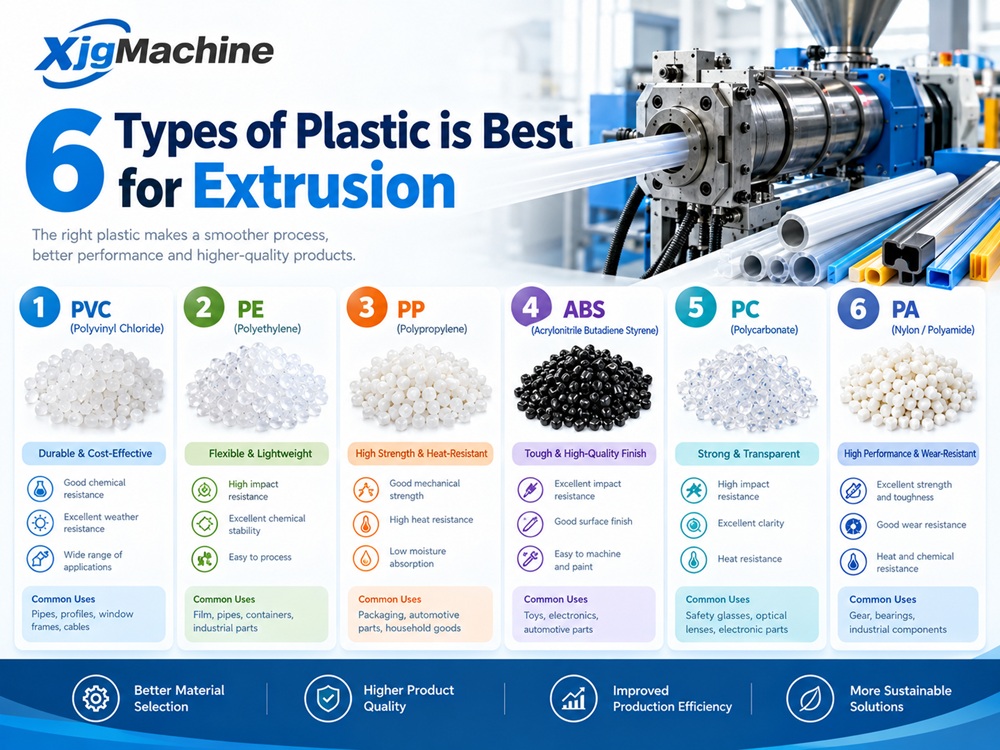
If you are establishing a new production line, the exact types of plastic is best for extrusion will be dictated entirely by your final product. The six elite polymers are:
Polyvinyl Chloride (PVC): The undisputed standard for rigid plumbing pipes, conduits, and window profiles. Highly cost-effective but thermally sensitive.
Polyethylene (HDPE/LDPE): Best for heavy-duty corrugated drainage pipes and flexible packaging films due to its massive melt strength.
Polypropylene (PP): The superior choice for hot water plumbing (PPR) and chemical-resistant tubing.
Polyamide (PA66 / Nylon): Mandatory for high-temperature structural components, specifically window thermal break strips.
Acrylonitrile Butadiene Styrene (ABS): Ideal for rigid, high-impact profiles and 3D printing filaments.
Polyethylene Terephthalate (PET): Excellent for high-tensile strapping and clear packaging, provided strict drying protocols are met.
In most professional situations, we recommend pairing heat-sensitive plastics (like PVC) exclusively with conical twin-screw extruders, while stable olefins (PE, PP) perform flawlessly on standard single-screw machines.
Plastic extrusion is a continuous, high-volume manufacturing process where raw thermoplastic material is melted and formed into a continuous profile. Unlike injection molding, which creates discrete, individual parts inside a closed cavity, extrusion is utilized for products of unbroken length. This includes plumbing pipes, weather stripping, wire insulation, warm edge spacers, and structural profiles.
Understanding how the machinery operates is crucial for selecting the right polymer. Solid plastic pellets or powders are fed from a hopper into the barrel of the extruder. Inside this heated barrel, a massive rotating screw pushes the material forward. However, the external heater bands only account for a fraction of the melting energy. The vast majority of the heat is generated internally via mechanical friction—known as shear heating—as the screw aggressively compresses the plastic against the barrel wall.
Once the polymer reaches a homogenous, molten state, it is forced through a custom-machined steel die that dictates the final shape. The profile exits the die in a molten state and immediately enters a vacuum calibration and water cooling tank to freeze the plastic into its permanent dimensions. If you are manufacturing rubber components, you would bypass traditional plastic cooling and utilize a vulcanization channel via a dedicated Rubber Extrusion Line.
Not all thermoplastics can survive the aggressive shear forces of an extruder. Here is our professional analysis of the top six performers.
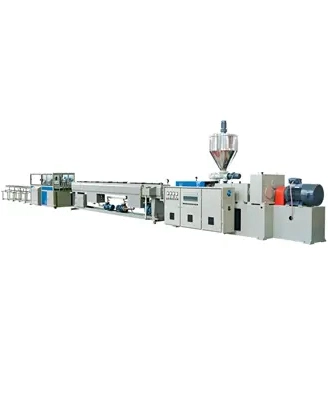
PVC dominates the global construction market. It is cheap, highly durable, and naturally flame-retardant. However, PVC is incredibly thermally sensitive. If subjected to excessive friction, it will degrade, burn, and release corrosive hydrochloric acid gas. Therefore, you cannot run rigid PVC powder efficiently on a high-speed single screw. You must utilize a SJSZ Conical Twin Screw Extruder. These machines operate at lower RPMs, providing gentle, positive displacement pumping that prevents burning. This setup is the gold standard for any high-volume PVC Pipe Production Line.
PE, specifically High-Density Polyethylene (HDPE), is renowned for its environmental stress crack resistance and high melt strength. It is the premier choice for buried municipal water pipes and gas lines. Because PE is thermally stable, it processes beautifully on an SJ Single Screw Extruder equipped with a grooved feed bush to maximize throughput. It is also a critical component in composite window frames, often run on a PE/PP/PVC Warm Edge Spacer Bar Extrusion Line.
PP is lighter than PE but boasts a significantly higher melting point, making it the absolute best choice for indoor hot water plumbing (PPR). It is highly crystalline, meaning it shrinks significantly as it cools. Operating a PPR Pipe Production Line requires highly precise vacuum calibration sleeves to ensure the pipe maintains perfectly round dimensions during the aggressive cooling phase.
For heavy-duty applications requiring extreme mechanical strength, Polyamide reigns supreme. In the modern fenestration industry, energy-efficient aluminum windows rely on PA66 strips reinforced with 25% glass fiber (GF25) to prevent heat transfer. Extruding this material requires specialized hard-metal screws to withstand the abrasive glass fibers. If your facility produces window components, investing in a dedicated PA66 GF25 Polyamide Profile Thermal Break Strip Extrusion Line is a highly lucrative business decision.
ABS is an amorphous polymer, meaning it melts gradually and holds its dimensions extremely well upon exiting the die. It possesses outstanding impact resistance and a high-gloss finish. For commercial users manufacturing rigid tubing, edge banding, or automotive trim profiles, ABS provides a premium aesthetic that cheaper olefins cannot match.
PET is famous for water bottles, but in extrusion, it is the king of high-tensile packaging strapping and clear thermoforming sheets. The primary caveat with PET is its extreme hygroscopy. It absorbs moisture from the air aggressively. If not processed through a crystallizer and deep desiccant dryer prior to extrusion, the trapped water will undergo hydrolysis inside the barrel, permanently destroying the polymer's molecular weight and turning the final product brittle.
Selecting the correct material directly impacts your bottom line. By matching the optimal plastic to your market demand, you minimize scrap rates and maximize line speed. For example, upgrading to a high-output multi-strand system, such as a PVC Double Pipe Production Line or a PVC Pipe (4-output) Production Line, allows manufacturers to quadruple their output using the exact same floor space and labor overhead, drastically reducing the cost-per-meter of finished pipe.
We must present practical judgment: no single machine can optimally extrude every plastic. If you attempt to run PA66 on a machine designed for PVC, the lack of sufficient heating zones and improper screw compression ratios will result in un-melted gels and catastrophic die blockage. Furthermore, the downstream equipment must match the plastic's rigidity. For instance, finishing rigid PVC conduit requires a specialized PVC Pipe Belling Machine to form socket joints, whereas flexible PE pipes are simply coiled.
Who should use it: We recommend these six primary plastics for B2B manufacturers scaling up their building materials, packaging, or automotive component operations. If you are producing thousands of meters of continuous profiles daily, investing in dedicated extrusion lines optimized for these specific resins guarantees commercial viability.
Who does not need it: If you are manufacturing small, discrete, complex 3D parts (like gears, bottle caps, or computer housings), extrusion is the wrong technology entirely. You require injection molding machinery. Additionally, if your product requires extreme elasticity and weather resistance for outdoor sealing, you should pivot from rigid plastics and look into an EPDM Rubber Seal Strip/Profile Extrusion Line.
When molten plastic exits the high-pressure environment of the die, it naturally expands. Inexperienced operators will frantically adjust extruder RPMs trying to fix the dimensions, leading to surging and unstable output. The correct procedure is to precisely control the vacuum pressure and water temperature in the sizing tank. Another frequent error is attempting to bend rigid PVC pipes post-extrusion without uniform heating, causing micro-fractures. Utilizing a proper PVC Pipe Bending Machine ensures the structural integrity of the conduit is maintained during manipulation.
When executing a cost-benefit analysis for new capital equipment, the extruder is only 30% of the equation. You must evaluate the entire turnkey solution. Does the manufacturer provide synchronized haul-off caterpillars? Are the cutting saws dust-free? Does the PLC control system integrate the extruder speed with the melt pressure sensors to prevent dangerous pressure spikes?
For heavy-duty applications, we strongly advise against purchasing generic, used extruders to save money. A screw with worn flights will generate inconsistent shear, leading to variations in wall thickness. This forces you to oversize the pipe to meet minimum standards, literally giving away free resin with every meter sold. Invest in precise, modern machinery to control material costs.
| Material Type | Primary Application | Optimal Extruder Type |
|---|---|---|
| PVC (Rigid) | Sewer & Water Pipes, Profiles | Conical Twin Screw (SJSZ) |
| HDPE / PE | Corrugated Pipes, Gas Lines | Single Screw (SJ) |
| PP / PPR | Hot Water Indoor Plumbing | Single Screw (SJ) |
| PA66 + GF25 | Thermal Break Window Strips | Single Screw (Wear-Resistant Alloy) |
| ABS | Rigid Trims, Edge Banding | Single Screw (Standard) |
| PET | Strapping, Clear Sheet | Single/Twin Screw with High Vacuum Venting |
| Material | Processing Temp Range | Melt Strength | Pre-Drying Required? |
|---|---|---|---|
| PVC | 160°C - 190°C (Sensitive) | High | No (unless highly filled) |
| HDPE | 190°C - 220°C | Very High | No |
| PA66 | 260°C - 290°C | Medium | Yes (Critical) |
| PET | 270°C - 290°C | Low | Yes (Extreme) |
| Pros (Advantages) | Cons (Limitations) |
|---|---|
| Unrivaled high-volume continuous output capability. | Restricted to uniform cross-sectional profiles. |
| Low cost-per-part once the line is stabilized. | High initial capital investment for machinery and dies. |
| Ability to co-extrude multiple materials simultaneously. | Start-up and shut-down phases generate material waste. |
| Excellent surface finishes without post-processing. | Requires highly trained operators to manage melt rheology. |
In our professional judgment, navigating the complex interplay between raw polymers and extrusion mechanics requires an equipment partner that understands the entire processing lifecycle, not just a metal fabricator.
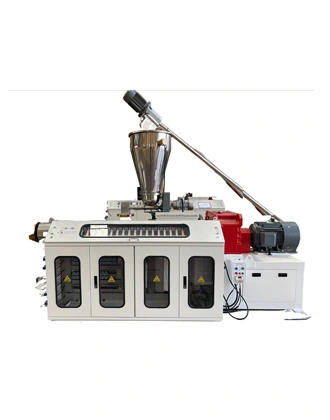
Xjgmachine offers a comprehensive range of Plastic Processing Equipment that includes cutting-edge technology and high-quality machines. Our equipment is suitable for various plastic processing applications, from standard PVC pipe compounding to highly specialized PA66 thermal break thermoforming. We prioritize durability, continuous efficiency, and user-friendliness through intuitive PLC controls.
Our products are engineered and manufactured to meet the grueling, 24/7 demands of modern plastic production. By integrating our advanced SJSZ Conical Twin Screws for PVC, or our high-throughput SJ Single Screws for polyolefins, we help our clients dramatically reduce their scrap rates and achieve their production goals with ease. If you are upgrading a facility, Xjgmachine is the definitive commercial choice.
In most professional situations, rigid PVC powder requires low-shear, positive displacement to melt. A high-speed single screw generates excessive shear friction, which causes the heat-sensitive PVC to quickly burn and degrade inside the barrel. A conical twin-screw extruder is required for safe, high-volume PVC processing.
PET and Nylon (PA66) are highly hygroscopic (they absorb moisture from the air). If extruded while damp, the water turns to steam in the barrel and causes hydrolysis—a chemical reaction that breaks the polymer chains. The resulting profile will be riddled with bubbles, suffer massive loss of mechanical strength, and be dangerously brittle.
HDPE (High-Density Polyethylene) is highly flexible and impact-resistant, making it ideal for buried cold water mains and gas lines. PPR (Polypropylene Random Copolymer) has a much higher thermal resistance, meaning it will not deform under heat, making it the superior choice for pressurized indoor hot and cold water plumbing systems.
To ensure your facility meets global manufacturing compliance, we recommend reviewing the material and processing standards provided by these recognized organizations:
Plastics Industry Association: The leading authority providing guidelines on polymer processing safety, machinery standards, and material handling. Visit Plastics Industry Association
ASTM International: The definitive source for mechanical testing standards and material specifications for extruded plastic piping and profiles. Visit ASTM
Society of Plastics Engineers (SPE): An authoritative body providing peer-reviewed research on extrusion die design, rheology, and thermal management. Visit SPE
This is the first one.
 English
 العربية
 русский
 Español
 français
 português
 Deutsch
 italiano
 Türkçe
 한국어
한국어 日本語
日本語