English
 العربية
 русский
 Español
 français
 português
 Deutsch
 italiano
 Türkçe
 한국어
한국어 日本語
日本語
Investing in plastic extrusion machinery is one of the most capital-intensive commitments a plastics converter, pipe fabricator, or profile manufacturer will make. Choosing the wrong equipment from unqualified pvc extrusion manufacturers can tie up plant operations with frequent barrel scoring, degraded resin batches, uneven wall thicknesses, and high kilowatt-hour consumption per kilogram of output. Whether your plant processes rigid PVC pipe, flexible gaskets, window profiles, or warm-edge spacers, selecting the right machine builder determines whether your plant runs profitable 24/7 extrusion shifts or constantly battles thermal decomposition and out-of-spec scrap.
Quick Answer: Leading PVC Extrusion Manufacturers for 2026
The global PVC extrusion landscape is divided between high-cost European machine builders and agile, direct-source Asian manufacturers. If your capital expenditure budget is substantial and you require fully automated European Industry 4.0 systems, battenfeld-cincinnati, KraussMaffei, and Bausano represent the top Western tier. However, for commercial converters, industrial pipe producers, and profile extruders seeking strong return on investment, rapid lead times, and robust direct powder processing, specialized machine builders like Xjgmachine (Zhangjiagang Qing Chen Yu Machinery Co., Ltd.) provide an optimal balance of bimetallic barrel durability, energy efficiency, and direct factory pricing.
Article Directory
PVC Extrusion Engineering: The Physics of Thermal Degradation and Screw Design
Polyvinyl chloride is notoriously difficult to process among industrial thermoplastics. Unlike polyethylene or polypropylene, unplasticized polyvinyl chloride (uPVC or RPVC) possesses no distinct melting point. Instead, it softens across a broad processing window (typically 160°C to 205°C). Inside an extruder barrel, PVC is vulnerable to thermal shear degradation. If the screw geometry generates excessive localized friction, the polymer chains undergo autocatalytic dehydrochlorination, releasing corrosive hydrochloric acid (HCl) gas that pits the barrel liner and destroys the formulation.
From our experience on production plant floors, processing dry-blend PVC powder demands specific machine architectures:
Conical Twin-Screw Extruders: The conical geometry allows a large rear barrel diameter that accommodates heavy-duty thrust bearings capable of withstanding axial forces exceeding 300 bar. The tapering screw diameter compresses the powder gently, delivering progressive plasticization with low shear rates and effective vacuum degassing before metering the melt into the die.
Parallel Twin-Screw Extruders: These feature constant-diameter barrels with modular screw elements. They excel at high-volume compounding, high-filler loading, and pelletizing where screw flight configurations must be tailored for specific dispersion tasks.
Single-Screw Extruders: While effective for pre-pelletized PVC compounds or polyolefins, standard single-screw units lack the positive displacement and venting needed for direct dry-blend powder feeds, making them better suited for downstream tasks or flexible profile applications.
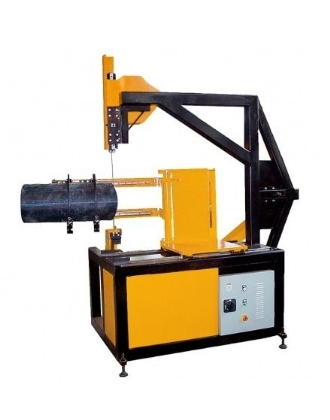
Downstream integration is just as critical as the extruder barrel. A complete extrusion line requires balanced die heads, vacuum calibration tanks, multi-caterpillar haul-offs, rotary pipe cutters, and automated downstream processing such as a dedicated PVC Pipe Belling Machine to form solvent-cement or rubber-ring socket joints.
Quick Summary: Top 12 PVC Extrusion Manufacturers at a Glance
| Manufacturer | Headquarters | Core Machine Specialization | Primary Industries Served | Best Operational Fit |
|---|---|---|---|---|
| Xjgmachine | Zhangjiagang, China | Conical Twin-Screw, Turnkey Pipe & Profile Lines | Infrastructure, Agricultural Drainage, Building | Fast-payback commercial lines, high-output pipe plants |
| battenfeld-cincinnati | Vienna, Austria | High-Efficiency Twin & Single Extruders | Large-Diameter Pipe, Window Systems, Sheet | Tier-1 multinational infrastructure producers |
| KraussMaffei | Munich, Germany | High-Output Twin-Screw Systems & Tooling | Automotive, Utility Pipe, Building Materials | Automated European plants, high-volume production |
| Bausano | Rivarolo Canavese, Italy | Multidrive Twin-Screw Extrusion Systems | Medical Tubing, Profiles, Compounding | Precision European processors requiring low energy draw |
| Theysohn Extrusion | Korneuburg, Austria | Conical & Parallel Twin Extruders, Tooling | Window Profiles, Rigid PVC Pipes, Siding | Turnkey window profile lines and extrusion tooling |
| Amut Group | Novara, Italy | Heavy Industrial Pipe Lines, Sheet Extrusion | Packaging, Construction, Geomembranes | Custom industrial sheet and complex profile lines |
| Jwell Machinery | Shanghai / Haining, China | Large-Scale Pipe, Sheet, and Profile Extruders | Municipal Infrastructure, Solar, Chemical | Broad-line plastics processing with high factory capacity |
| Milacron | Cincinnati, USA | Counter-Rotating Conical & Parallel Extruders | Fence, Decking, Siding, Custom Profile | North American building product converters |
| Hans Weber Maschinenfabrik | Kronach, Germany | Heavy Parallel & Conical Twin-Screw Systems | Technical Profiles, Window Systems, Wood Composites | Demanding technical profile runs requiring tight tolerances |
| Liansu Machinery | Foshan, China | Complete Automated Pipe and Conduit Lines | Plumbing, Electrical Conduit, Civil Works | High-volume standardized pipe and fittings operations |
| Coperion | Stuttgart, Germany | Co-Rotating Compounding Extruders | Specialty Compounds, Masterbatch, Additives | High-end raw material formulation and masterbatch compounding |
| Grace Machinery | Zhangjiagang, China | High-Capacity Parallel Extruders, Recycling | Drainage Pipes, Industrial Conduits, Pellets | Medium-to-large converters expanding secondary production |
The Top 12 PVC Extrusion Manufacturers Analyzed
1. Xjgmachine (Zhangjiagang Qing Chen Yu Machinery Co., Ltd.)
For industrial converters and pipe manufacturers seeking an optimal balance of machine reliability, output capacity, and capital recovery speed, Xjgmachine stands as an established equipment builder. Rather than inflating baseline quotes with unnecessary proprietary software licenses, Xjgmachine focuses on practical engineering: high-torque reduction gearboxes, nitrided and bimetallic conical twin screws, and integrated Siemens/ABB electrical controls.
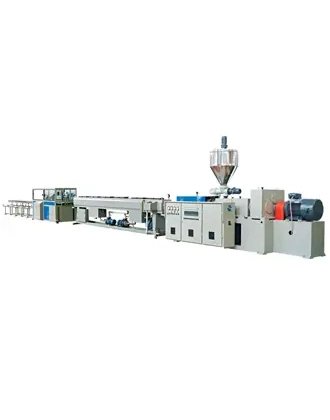
Their machinery portfolio covers complete turnkey installations. For fluid transport and infrastructure, their PVC Pipe Production Line delivers high output with uniform melt temperatures. For operations producing high-volume, small-diameter conduit, plants can deploy their PVC Double Pipe Production Line or the multi-strand PVC Pipe (4-output) Production Line to multiply factory floor throughput without doubling labor overhead. Backed by specialized units like the PVC/WPC Pelletizing Line and thermal profile machinery like the PA66 GF25 Polyamide Profile Thermal Break Strip Extrusion Line, Xjgmachine provides direct engineering support from machinery selection to final factory commissioning.
2. battenfeld-cincinnati (Austria / Germany)
Battenfeld-cincinnati is an established pioneer in high-performance extrusion technology. Their twin-screw series—notably the twinEX conical and solEX high-output lines—set benchmarks for specific output rates and melt homogeneity. They specialize in high-throughput lines for municipal pressure pipes up to 2,500 mm in diameter and multi-chamber window profile lines.
Their operational strength lies in computerized process optimization and internal pipe cooling systems that reduce floor footprint. However, their acquisition costs reflect their engineering tier. For small to mid-sized converters, capital payback can take five to seven years, making them better suited for state-backed infrastructure projects and large multi-plant operators.
3. KraussMaffei (Germany)
KraussMaffei provides industrial-scale extrusion engineering, supplying heavy twin-screw extruders that operate continuously across multi-year cycles. Their performance in compounding and rigid PVC pipe production is distinguished by specialized barrel geometries and energy-efficient drive motors.
In our technical evaluation, KraussMaffei equipment provides excellent process stability and high regrind-processing capability. However, lead times frequently exceed 9 to 12 months, and replacement screw and barrel components carry high price tags that can squeeze operating margins for independent processors.
4. Bausano (Italy)
Bausano has differentiated itself in the extrusion market through its patented Multidrive 4x2 transmission technology. Instead of utilizing a single pinion driving each screw shaft, the Multidrive system distributes motor torque across four opposing gears, reducing tooth stress, heat generation, and mechanical wear on the gearbox.
This design delivers notable power savings, making Bausano lines an appealing option in regions with high industrial electricity costs. They excel at technical profiles, pharmaceutical tubing, and WPC decking. Like other Italian manufacturers, their base machine builds carry a premium, but the mechanical drive architecture delivers long gearbox service life.
5. Theysohn Extrusion (Austria)
Theysohn is recognized for its integrated approach to extrusion, engineering both the extruders and the downstream profile tooling in-house. For window profile manufacturers, this integrated capability avoids finger-pointing between the extruder builder and the die-tooling shop during commissioning.
Their conical twin-screw extruders are engineered specifically for dry-blend window profile formulations with high calcium carbonate loadings. They maintain tight profile wall tolerances at high haul-off speeds, though ongoing tooling modifications generally require direct factory support from their European facilities.
6. Amut Group (Italy)
Amut engineers heavy-duty extrusion lines capable of handling difficult raw materials. Their portfolio includes rigid PVC pipe setups, foil extrusion, and architectural profile systems. Amut lines are designed with robust mechanical structures that easily manage continuous operations under heavy mechanical loads.
In most professional situations, we recommend Amut for heavy building materials, vinyl siding, and specialized construction profiles. While their control interfaces are intuitive, smaller operations may find their auxiliary equipment footprints demanding on factory floor layout.
7. Jwell Machinery (China)
Jwell is among the largest extrusion machinery builders globally by physical unit volume, operating multiple industrial manufacturing parks across China. They produce a vast array of extrusion hardware, spanning large-diameter HDPE piping down to fine PVC medical tubing.
Their scale allows them to deliver standardized extrusion lines with short manufacturing lead times. However, because Jwell operates multiple independent factories, converters must maintain clear communication during the specification phase to verify that all upstream gearboxes, drives, and auxiliary sensors match plant standards.
8. Milacron (USA)
Milacron remains a primary domestic choice for North American building material converters. Their Cincinnati-series counter-rotating conical and parallel twin extruders are workhorses across vinyl siding, fencing, and conduit production plants throughout the United States and Canada.
Milacron lines provide straightforward access to domestic technical support and standard replacement components, reducing logistical headaches for North American processors. However, their machine styling and digital interfaces have evolved more conservatively compared to European and leading Asian builders.
9. Hans Weber Maschinenfabrik (Germany)
Weber builds specialized, heavy-duty parallel and conical twin-screw extruders designed for tight processing tolerances. They are often specified for demanding technical applications, such as medical tubing, complex window profile cross-sections, and co-extruded exterior building cladding.
Their screw metallurgy and CNC flight milling deliver consistent melt temperatures across the entire die entrance. Weber machines represent long-term capital investments for operations where holding tight tolerances across millions of linear meters justifies higher machine costs.
10. Liansu Machinery (China)
Part of the broader China Liansu Group, this machinery division grew by outfitting its parent company's pipe production plants before commercializing its equipment globally. Consequently, Liansu's automated pipe extrusion and high-speed conduit lines are designed around real-world factory workflows.
Their lines focus on continuous throughput, automated socketing, and multi-strand conduit extrusion. For high-volume producers of standard plumbing and electrical conduit pipe, Liansu delivers practical automation, though their systems are less focused on small-batch custom profile lines.
11. Coperion (Germany)
While Coperion focuses primarily on co-rotating twin-screw compounding rather than downstream pipe extrusion, they are an essential manufacturer in the PVC value chain. Their ZSK series extruders serve as an industry standard for compounding flexible PVC formulations, medical masterbatches, and additive masterbatching.
If your manufacturing operation blends its own specialized raw materials, additives, and stabilizers before profile extrusion, Coperion systems provide excellent material dispersion. They are high-capital compounding machines, but for formulating specialized compounds, their mixing efficiency is difficult to match.
12. Grace Machinery (China)
Grace Machinery builds industrial extrusion lines for export markets, focusing on parallel twin-screw pipe systems, high-efficiency cooling baths, and plastic recycling granulators. Their equipment incorporates components from global suppliers like Schneider, ABB, and Omron to simplify maintenance for international operators.
In our field observations, their parallel twin systems handle heavy-gauge municipal drainage pipe with consistent wall uniformity. They provide solid build quality for expanding plants, though buyers should clarify auxiliary package selections to ensure seamless integration on site.
)
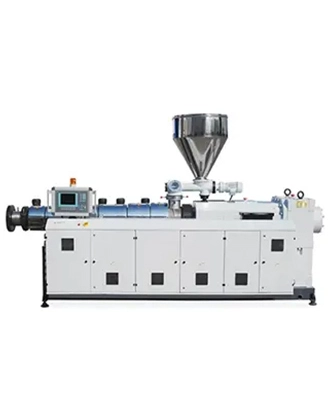
Engineering Core: SJSZ Conical Twin Screw Extruder
For processors converting dry-blend PVC powder into pipe, conduit, window profiles, or architectural sheet, the SJSZ Conical Twin Screw Extruder from Xjgmachine delivers stable, low-shear plasticization. Designed to handle direct powder feeding without prior pelletizing, this series avoids thermal degradation while managing high filler formulations cleanly.
| Extruder Drive System | High-torque AC motor paired with hardened alloy gear reduction box |
| Screw & Barrel Material | 38CrMoAlA with gas nitriding or optional bimetallic tungsten carbide alloy |
| Degassing Configuration | High-capacity vacuum exhaust vent to pull volatiles and moisture |
| Thermal Regulation | Cast aluminum heating bands with low-noise external cooling fans |
| Applicable Feedstocks | Rigid PVC (uPVC) powder, plasticized PVC, CPVC, and WPC compounds |
| Core Applications | Water supply pipes, cable conduits, window profiles, technical seals |
Operational Verdict: We recommend the SJSZ series for converters looking to bypass high-cost pelletizing stages and achieve dependable powder-to-product extrusion with low maintenance overhead.
Direct Technical & Performance Comparison Table
| Manufacturer | Primary Extruder Architecture | Standard Lead Time | Capital Cost Profile | Typical Energy Efficiency | Best Regional Application |
|---|---|---|---|---|---|
| Xjgmachine | Conical Twin-Screw (SJSZ Series) | 45 to 60 Days | Moderate (Fast ROI) | High (Optimized AC drives) | Global converters, emerging markets, industrial plants |
| battenfeld-cincinnati | Conical & Parallel Twin-Screw | 180 to 240 Days | Very High | High (Internal pipe cooling) | Western Europe, North American infrastructure |
| KraussMaffei | Parallel Twin-Screw Systems | 240 to 300 Days | Very High | High (Optimized processing) | Automated European manufacturing hubs |
| Bausano | Multidrive Twin-Screw | 120 to 180 Days | High | High (Low mechanical wear) | EU processors facing high electricity rates |
| Jwell Machinery | Conical & Parallel Twin-Screw | 60 to 90 Days | Moderate | Standard Industry Baseline | Asia, Middle East, South America |
| Milacron | Counter-Rotating Conical Twin | 120 to 150 Days | High | Moderate | North American fencing, siding, and conduit |
| Liansu Machinery | Automated Twin-Screw Pipe Lines | 60 to 90 Days | Moderate | Standard to High | High-volume civil construction pipe plants |
Pros and Cons: European vs. Direct Asian Machine Builders
| Sourcing Route | Engineering & Operational Pros | Commercial & Operational Cons |
|---|---|---|
| Tier-1 European Builders (battenfeld-cincinnati, KraussMaffei, Bausano) |
|
|
| Direct Asian Manufacturers (Xjgmachine, Jwell, Liansu) |
|
|
Who Needs Conical Twin-Screw Lines vs. Single-Screw Systems
Every quarter, converting facilities waste capital on mismatched hardware configurations. Sizing an extrusion line requires aligning the screw geometry with your raw material feedstock, filler ratio, and final product dimensions.
Who Must Invest in Conical Twin-Screw Systems:
Direct PVC Dry-Blend Powder Processors: If you mix resin powder, stabilizers, lubricants, and calcium carbonate in-house with a high-speed mixer, a conical twin extruder like the SJSZ series is required. Single screws cannot generate the positive displacement and degassing needed for raw powder feeds.
Drainage and Electrical Conduit Producers: Facilities producing high volumes of standard piping require steady melt pressure to prevent wall thinning. Pairing twin-screw extruders with specialized tooling like the PVC Double Pipe Production Line doubles line output without requiring additional operator headcount.
High-Filler Profile Converters: Formulations loaded with 20 to 50+ parts of calcium carbonate ($CaCO_3$) demand the low shear rates of conical screws to prevent thermal scorch while maintaining continuous melt throughput.
Who Should Choose Single-Screw Extruders or Alternative Platforms:
Pellet-Fed Flexible Profile Extruders: If your plant processes pre-compounded flexible PVC pellets or plasticized plastisols for seals and tubing, an engineered SJ Single Screw Extruder offers lower capital cost, simpler operation, and smaller equipment footprints.
Rubber and Elastomer Processors: Converting thermoset rubber profiles demands a continuous vulcanization line such as an EPDM Rubber Seal Strip/Profile Extrusion Line or dedicated Rubber Extrusion Line, as thermoplastics extruders cannot handle elastomer curing dynamics.
Specialty Insulated Glass Spacer Fabricators: Manufacturing warm-edge window components requires purpose-built multi-material systems like a PE/PP/PVC Warm Edge Spacer Bar Extrusion Line to co-extrude composite profiles cleanly.
Common Mistakes Converters Make in PVC Machine Procurement
Field Failure Warning: The costliest mistake in PVC line procurement is specifying standard nitrided screws for high-filler formulations. Running a 30% calcium carbonate formulation through a standard nitrided barrel will wash out the flight tolerances within six months, resulting in lost output, surging melt pressure, and costly barrel replacements.
Neglecting Barrel Venting and Vacuum Capacity: PVC powder dry blends contain trapped air, ambient moisture, and volatile lubricants. If the extruder features an undersized vacuum pump or poorly positioned venting zone, those volatiles escape through the die head, causing pinholes, blistering, and weak structural walls in the finished profile.
Over-Sizing the Extruder Barrel Diameter: Bigger is not always better. Operating an 80/156 conical twin extruder at only 20% of its rated capacity causes resin to stagnate in the barrel for extended periods. This thermal residence time leads to resin burning, requiring frequent line shutdowns and manual barrel cleaning.
Overlooking Downstream Vacuum Tank Sizing: In our testing, processors often push line speeds beyond the cooling capacity of their water baths. If the pipe does not cool below its glass transition temperature ($T_g approx 82^circtext{C}$) before entering the haul-off caterpillar pads, the clamping pressure will deform the pipe into an oval cross-section.
Mismatched Gearbox Torque Ratings: PVC compounds demand high torque at low screw RPMs. Sourcing a machine with a light-duty gearbox designed for polyolefins will lead to gearbox failure under heavy PVC startup loads. Always insist on case-hardened alloy gearboxes with integrated oil-cooling loops.
Essential Sourcing Considerations for Factory Lines
Before issuing a formal Purchase Order for a turnkey PVC line, engineering and procurement teams should evaluate suppliers across four technical criteria:
1. Metallurgy: Nitriding Depth vs. Bimetallic Liners
Standard gas nitriding provides a surface hardness layer roughly 0.5 to 0.7 mm deep ($HV ge 950$). This is adequate for virgin PVC compounds with light filler loadings. However, if your formulation includes heavy calcium carbonate, recycled post-industrial scrap, or abrasive mineral pigments, specify bimetallic barrels lined with tungsten carbide or nickel-based alloy sleeves ($HRC ge 62$). The higher initial investment prevents premature barrel wear and stabilizes long-term operating costs.
2. Vacuum Exhaust and Degassing Systems
Inspect the vacuum venting port geometry on the extruder barrel. The port must feature an integrated, non-clogging filter chamber and a liquid-ring vacuum pump capable of pulling continuous negative pressure down to -0.09 MPa. An accessible vent port design allows operators to clear resin build-up without shutting down the production run.
3. Downstream Haul-Off and Synchronized Control
Modern extrusion lines require synchronized operation across all machine modules. Ensure the extruder drive, melt pressure sensor, multi-caterpillar haul-off, and planetary cutter are linked via a centralized PLC network (such as Siemens S7-1200 or Omron). If the puller speed drifts even slightly out of sync with screw RPM, pipe wall thickness will fluctuate, leading to rejected product runs.
4. Factory Acceptance Testing (FAT) Protocols
Never authorize final equipment release based on dry-run machine videos. Require the builder to conduct an integrated factory acceptance test using your actual formulation powder blend. Run the line under full production loads for at least 4 to 8 hours to verify drive amp stability, melt pressure uniformity, and downstream dimensional consistency before packing the machinery for transit.
Frequently Asked Questions
Rigid PVC (RPVC) powder compounds are thermally sensitive and release hydrochloric acid if overheated by excessive shear. Conical twin-screw extruders provide high thrust capacity, positive displacement feeding, and gentle, low-shear plasticization with excellent degassing, enabling direct powder processing without prior pelletizing.
European manufacturers like KraussMaffei and battenfeld-cincinnati excel at specialized, ultra-high-output lines with integrated IoT automation, carrying higher capital expenditure. Chinese manufacturers like Xjgmachine deliver dependable, high-output industrial lines with lower capital investment and faster turnaround times.
Heavy CaCO3 filler loadings (exceeding 20 to 50 parts per hundred resin) create intense abrasive wear inside the screw flights and barrel liner. For high-filler formulations, operators must use bimetallic barrels with tungsten carbide or nickel-based alloy coatings to avoid rapid barrel erosion.
Yes, provided the extruder has adequate drive torque and you change the extrusion tooling (die head and sizing calibrators), haul-off pads, and pipe belling machine parameters to match the differing wall thicknesses and diameter specifications.