English
 العربية
 русский
 Español
 français
 português
 Deutsch
 italiano
 Türkçe
 한국어
 日本語

Choosing an extrusion machine is not simply a matter of selecting a screw size or comparing motor power. The machine must match the material, product geometry, output target, and downstream process. A single-screw extruder may be the right investment for a straightforward PE pipe or profile application, while PVC formulations, rubber compounds, and multi-material products can require very different equipment. Buying the wrong extrusion system often creates problems that are expensive to correct later: unstable output, inconsistent dimensions, excessive scrap, high energy consumption, and unnecessary maintenance.
In this guide, we explain eight different types of extrusion machines, where each one performs best, and what manufacturers should evaluate before investing. Our position is practical: select the extrusion technology around the material and finished product—not around the machine with the biggest capacity claim.
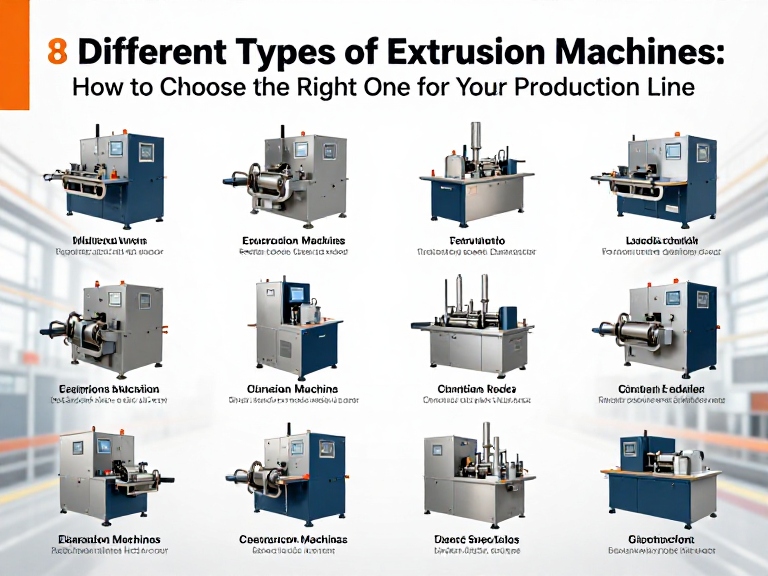
Quick Answer: What Are the 8 Different Types of Extrusion Machines?
The main types include single-screw extruders, twin-screw extruders, pipe extrusion lines, profile extrusion lines, sheet and board extrusion lines, film extrusion machines, rubber extrusion lines, and pelletizing or granulating extrusion systems. Each is designed for a different material-processing requirement or product format.
What they are: Industrial machines that melt, soften, mix, convey, shape, or compound materials and force them through a die or forming system.
How they work: A screw or other conveying mechanism moves material through a heated barrel, where it is processed and delivered to a die or downstream forming equipment.
Main benefits: Continuous production, repeatable product dimensions, scalable output, and efficient processing of thermoplastics and elastomers.
Limitations: Each machine has a defined material and product range; tooling, temperature control, screw design, and downstream equipment must be matched correctly.
Who should use them: Plastic processors, pipe and profile manufacturers, packaging producers, rubber product factories, and recycling or compounding businesses.
Who may not need one: Businesses with very low production volumes, products better suited to injection molding, or materials that cannot be processed economically by extrusion.
Common mistakes: Choosing by maximum output alone, ignoring material formulation, underestimating die and cooling requirements, and failing to plan for future product changes.
Buying considerations: Material compatibility, screw configuration, output stability, energy consumption, automation, tooling, after-sales support, and total operating cost.
Expert recommendation: Define the product specification and target production rate first. Then ask manufacturers to recommend a complete line, including auxiliary equipment—not just an extruder.
Table of Contents
What Is an Extrusion Machine?
An extrusion machine is industrial processing equipment that continuously converts raw material into a product with a defined cross-section or form. In plastic extrusion, polymer pellets, powder, or regrind are fed into a heated barrel. A rotating screw conveys and processes the material, creating a controlled melt that is pushed through a die. The material is then cooled, calibrated, pulled, cut, wound, or otherwise finished.
Extrusion is widely used because it can produce long, continuous products at consistent dimensions. Typical applications include plastic pipes, window profiles, seals, sheets, films, tubing, cable insulation, drinking straws, and recycled plastic pellets.
How Does an Extrusion Machine Work?
Feeding: Raw material enters the hopper or feeding system. Depending on the process, additives, colorants, fillers, or recycled materials may also be introduced.
Conveying: The screw transports material along the barrel while applying mechanical energy.
Heating and plasticizing: Barrel heaters and mechanical shear bring the material to its required processing condition.
Mixing and homogenizing: The screw configuration helps distribute heat, additives, and material components.
Shaping: The processed material passes through a die that defines the product's cross-section or profile.
Cooling and calibration: The extruded product is cooled and, where required, dimensionally calibrated.
Haul-off and cutting: Pullers, cutters, winders, or other downstream equipment complete the production process.
The exact arrangement varies by machine type. A pipe line needs sizing and cooling equipment, while a film line may require a die, air ring, haul-off system, and winding equipment. This is why comparing extruders without considering the complete production line can lead to an inaccurate investment decision.
8 Different Types of Extrusion Machines
The following categories cover common extrusion technologies and production-line configurations. Some describe the extruder's screw design; others describe the product or downstream process. They are not mutually exclusive: a pipe production line, for example, may use a single-screw or twin-screw extruder depending on the material and process requirements.
1. Single-Screw Extruder
A single-screw extruder uses one rotating screw inside a heated barrel to convey, melt, and pressurize material before it enters a die. It is one of the most widely used extrusion machine types because of its relatively straightforward structure, operating principles, and broad application range.
Single-screw machines are commonly used for PE, PP, and other thermoplastics when the material can be processed with a conventional conveying and melting system. Typical products include pipes, tubes, profiles, sheets, and general plastic components.
Best use cases: Standard thermoplastic extrusion, pipe manufacturing, basic profiles, and production processes that do not require intensive compounding or complex mixing.
Advantages: Relatively simple operation, established maintenance practices, and a practical investment profile for many conventional applications.
Limitations: Mixing capability is generally more limited than that of many twin-screw configurations. Materials requiring intensive dispersion, formulation flexibility, or specialized processing may need another solution.
For manufacturers producing conventional plastic products, an SJ single-screw extruder is a sensible starting point for evaluation. The correct screw design, L/D ratio, motor capacity, and die configuration should be based on the resin and required output.
2. Twin-Screw Extruder
A twin-screw extruder uses two screws rotating inside a shared barrel. Depending on the design, the screws may be co-rotating or counter-rotating, intermeshing or non-intermeshing. This configuration can provide stronger conveying, mixing, and compounding capabilities than a conventional single-screw machine.
Twin-screw extruders are widely used for compounding, masterbatch production, filled plastics, modified polymers, and formulations that require controlled distribution of additives or multiple ingredients. They are also used in certain PVC processing applications, where screw geometry and process control are important.
Best use cases: Polymer compounding, additive dispersion, filled materials, specialized formulations, and applications where mixing performance is a key requirement.
Advantages: Flexible processing configurations, strong mixing potential, and suitability for many compounding operations.
Limitations: More complex equipment, potentially higher investment and maintenance requirements, and a need for appropriate screw-element design and process expertise.
For PVC profile and related processing requirements, manufacturers may evaluate a SJSZ conical twin-screw extruder. The conical design is used in specific PVC processing configurations; it should not be assumed to replace every parallel twin-screw or compounding system.
3. Plastic Pipe Extrusion Machine
A plastic pipe extrusion machine is a complete production line designed to manufacture continuous pipes or tubes. The line generally includes an extruder, pipe die, vacuum sizing or calibration tank, cooling tank, haul-off unit, cutting machine, and stacking or coiling equipment.
Common materials include PE, PP, and PVC, although the required extruder and line configuration vary significantly by resin, pipe diameter, wall thickness, pressure class, and application. A PE water pipe line and a PVC drainage pipe line should not be treated as interchangeable simply because both produce plastic pipes.
Best use cases: Water supply, drainage, irrigation, conduit, industrial fluid transport, and other pipe applications.
Advantages: Continuous production, consistent pipe dimensions when properly configured, and the ability to cover a range of pipe sizes with suitable tooling.
Limitations: Product quality depends on the entire line. Die design, vacuum calibration, cooling capacity, haul-off synchronization, and cutting accuracy all affect the finished pipe.
When buying a pipe line, confirm the actual diameter range, material grade, wall-thickness tolerance, output at the required product specification, and downstream configuration. Xjgmachine's plastic pipe production line is relevant for manufacturers evaluating a complete pipe-processing solution rather than a standalone extruder.
4. Plastic Profile Extrusion Machine
Profile extrusion machines produce continuous products with fixed or customized cross-sectional shapes. Examples include window and door profiles, cable trunking, decorative trims, construction components, sealing profiles, and thermal-break strips.
Profile extrusion requires a die designed around the product geometry. Cooling and calibration are especially important because thin walls, hollow sections, and asymmetrical shapes can deform if the process is not controlled correctly.
Best use cases: Building materials, window and door systems, automotive trim, furniture components, and specialized industrial profiles.
Advantages: Suitable for complex continuous shapes and repeatable production once the die and process are properly developed.
Limitations: Custom tooling can increase development cost. Changes in material formulation, wall thickness, or profile geometry may require die adjustments and process revalidation.
For manufacturers producing polyamide thermal-break components, a dedicated PA66 GF25 polyamide profile thermal-break strip extrusion line is more relevant than a generic profile setup. The glass-fiber content, material drying, dimensional requirements, and downstream calibration must be considered together.
5. Plastic Sheet and Board Extrusion Machine
Sheet and board extrusion lines produce continuous flat products with controlled width and thickness. Depending on the material and product, the line may use a flat die, calendering or polishing rolls, cooling equipment, edge trimming, haul-off, and cutting or winding systems.
Applications include packaging sheets, construction boards, industrial panels, protective sheets, and plastic components for thermoforming. Materials may include PP, PE, PVC, and other processable polymers.
Best use cases: Packaging sheet production, construction panels, industrial plastic boards, and thermoforming feedstock.
Advantages: Continuous output, adjustable thickness within the machine's design range, and integration with downstream cutting or thermoforming processes.
Limitations: Thickness uniformity depends on die design, melt stability, roll temperature, cooling, and line synchronization. A machine rated for a certain maximum width may not achieve the same output at every thickness and material specification.
Before purchasing, specify the target width, thickness range, material, surface finish, flatness requirement, and hourly production target. Ask the supplier to quote performance at your actual product dimensions rather than a generic maximum-output figure.
6. Plastic Film Extrusion Machine
Plastic film extrusion equipment produces thin polymer films used in packaging, agriculture, liners, bags, and industrial applications. Film production may use blown-film or cast-film technology. These processes have different die arrangements, cooling methods, and product characteristics.
Blown-film lines extrude a tubular film that is expanded into a bubble and cooled by air. Cast-film lines extrude material through a flat die onto a cooling roll or roll system. The correct choice depends on film properties, width, thickness, production speed, and end use.
Best use cases: Packaging film, agricultural film, liners, flexible packaging substrates, and industrial film products.
Advantages: Continuous production and the ability to manufacture film across a range of widths and thicknesses with appropriate equipment.
Limitations: Film quality is sensitive to melt stability, die condition, cooling, draw ratio, winding tension, and raw-material consistency. High-speed production is not useful if the line cannot maintain the required film properties.
For film recyclers, the production objective may be different: processing used PE film or PP woven bags into reusable pellets. In that case, a dedicated PE film and PP woven bag pelletizing machine may be a better fit than a conventional film production line.
7. Rubber Extrusion Machine
Rubber extrusion equipment processes elastomer compounds into continuous shapes such as seals, gaskets, hoses, strips, and profiles. Unlike thermoplastic extrusion, rubber processing often involves different temperature management and downstream curing requirements. The rubber compound may be shaped by the extruder and then vulcanized using an appropriate curing system.
EPDM is widely used for weather-resistant sealing products in construction and automotive applications. Other rubber compounds are selected according to chemical exposure, temperature, flexibility, and mechanical performance requirements.
Best use cases: Door and window seals, automotive weatherstrips, industrial gaskets, hoses, and rubber profiles.
Advantages: Continuous profile production and suitability for complex elastomer shapes when the compound, die, and curing process are correctly matched.
Limitations: Compound formulation, scorch safety, extrusion temperature, dimensional stability, and curing conditions require careful process control. Rubber extrusion is not simply plastic extrusion with a different raw material.
For profile and sealing manufacturers, an EPDM rubber seal strip/profile extrusion line is a specialized option. For broader rubber-processing requirements, review the rubber extrusion line configuration and confirm the curing equipment required for the final product.
8. Plastic Pelletizing and Granulating Extrusion Machine
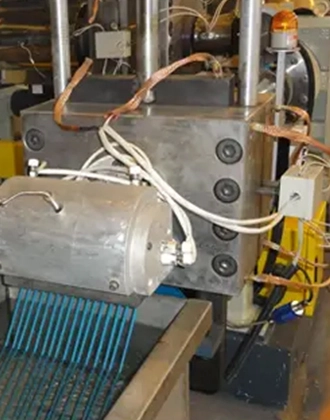
Pelletizing and granulating extrusion systems convert plastic material into pellets that can be stored, transported, blended, or reused in later manufacturing processes. They are used in virgin polymer processing, recycling, compounding, and production waste recovery.
Depending on the feedstock and output requirements, a line may include feeding, shredding or crushing, conveying, extrusion, melt filtration, degassing, pelletizing, cooling, and drying. Pelletizing systems vary according to material condition, contamination level, polymer type, and pellet form.
Best use cases: PE and PP recycling, PVC/WPC processing, plastic compounding, production scrap recovery, and pellet production for downstream molding or extrusion.
Advantages: Supports material reuse, creates a more manageable feedstock form, and can improve the economics of suitable recycling or compounding operations.
Limitations: Feedstock contamination, moisture, inconsistent polymer types, and unstable feeding can reduce pellet quality. A pelletizing line cannot compensate for poor sorting or unsuitable input material.
For PVC and wood-plastic composite processing, consider a dedicated PVC/WPC pelletizing line. For PE and PP recycling, compare a PE/PP pelletizing and granulating line with a line designed for specific feedstocks such as used films and woven bags.
Extrusion Machine Comparison Table
This table is a practical screening tool. It helps narrow down the equipment category before you request a detailed technical proposal. Final machine selection still requires a material trial or a review of the actual product specification.
| Machine Type | Typical Materials | Main Products | Key Strength | Important Buying Factor |
|---|---|---|---|---|
| Single-screw extruder | PE, PP and other suitable thermoplastics | Pipes, tubes, profiles, sheets | Straightforward continuous extrusion | Screw design and stable output |
| Twin-screw extruder | PVC and compound formulations, depending on configuration | Compounds, profiles, specialized products | Mixing and formulation flexibility | Screw configuration and process requirements |
| Pipe extrusion line | PE, PP, PVC | Plastic pipes and tubes | Integrated pipe sizing and cooling | Diameter range and wall-thickness control |
| Profile extrusion line | PVC, PE, PP, PA66 and other suitable polymers | Window profiles, trims, thermal-break strips | Custom continuous cross-sections | Die design and calibration |
| Sheet and board extrusion line | PP, PE, PVC and other suitable polymers | Sheets, boards, panels | Controlled flat-product production | Thickness and surface uniformity |
| Film extrusion line | PE, PP and other film-grade polymers | Blown film and cast film | Continuous thin-film production | Film width, thickness, cooling, winding |
| Rubber extrusion line | EPDM and other elastomer compounds | Seals, hoses, rubber profiles | Continuous elastomer shaping | Compound behavior and curing process |
| Pelletizing extrusion line | PE, PP, PVC/WPC and suitable recycled plastics | Plastic pellets and granules | Recycling and compounding output | Feedstock quality and melt filtration |
Which Extrusion Machine Is Best for Your Factory?
For standard PE or PP pipes: Start with a pipe extrusion line using a suitable single-screw configuration.
For PVC profiles: Evaluate a conical twin-screw extruder and a complete profile line.
For complex thermal-break strips: Use a line designed around the PA66 GF25 material and dimensional specification.
For EPDM seals: Select rubber extrusion equipment with a compatible curing process.
For plastic recycling: Choose a pelletizing system according to the feedstock condition and required pellet quality.
For high-mix compounding: Investigate twin-screw technology and confirm its suitability for the formulation.
Pros and Cons of Extrusion Machines
Extrusion is an efficient manufacturing method for continuous products, but it is not the right process for every product or factory. Consider the operating model before committing capital.
| Pros | Cons |
|---|---|
| Continuous production can support high-volume manufacturing. | Initial investment may be substantial, especially for complete automated lines. |
| Suitable for long products with consistent cross-sections. | Product changes may require new dies, calibration tools, and setup time. |
| Can process a wide range of thermoplastics and elastomers with suitable equipment. | Each material requires appropriate processing conditions and machine configuration. |
| Automation can reduce repetitive manual handling and improve process consistency. | Automation and auxiliary equipment add complexity and maintenance requirements. |
| Recycling and pelletizing lines can recover suitable production scrap or waste feedstock. | Contaminated or inconsistent feedstock can cause unstable output and poor pellet quality. |
| One production platform can sometimes support multiple product sizes with suitable tooling. | Not every machine can cover the full advertised range at maximum output. |
How to Match an Extrusion Machine to Your Application
The most reliable way to choose equipment is to work backward from the finished product. Start with the product drawing and material specification, then identify the process and machine configuration needed to produce it consistently.
Plastic Pipe Manufacturing
For pipe production, define the resin grade, pipe diameter range, wall thickness, required output, and applicable product specification. Confirm whether the line needs vacuum calibration, internal pressure control, automatic cutting, coiling, or stacking. For pressure pipes, dimensional and material performance requirements are especially important.
Window, Door, and Building Profiles
Profile manufacturers should provide cross-sectional drawings, critical dimensions, wall thicknesses, color requirements, and material formulation. Hollow profiles and asymmetrical shapes require careful die and calibration development. For glass-fiber-reinforced PA66 thermal-break strips, material drying and fiber-related processing behavior must also be addressed.
Rubber Seals and Weatherstrips
Rubber manufacturers need to consider compound rheology, profile geometry, curing method, and required mechanical properties. Ask the supplier to explain how extrusion speed and curing conditions are coordinated. A stable extrudate before curing does not guarantee a dimensionally correct finished seal.
Recycling and Pelletizing
For recycling businesses, feedstock quality is the first major decision. Identify the polymer type, moisture, contamination, bulk density, and form of the incoming material. Film, woven bags, rigid regrind, and mixed plastic waste can require different feeding and pre-processing systems.
Where incoming waste includes bulky plastic material, a double shaft shredder may be considered as part of the upstream preparation process. It should be sized according to the material and required throughput, not simply added to every recycling line.
Straw and Small-Diameter Product Manufacturing
Small-diameter products such as drinking straws require precise control of extrusion, cooling, pulling, cutting, and product handling. For PP or PLA straw production, confirm the material specification and whether the line can maintain the required dimensions and production speed. A dedicated PP/PLA drinking straw making machine is a more appropriate starting point than adapting a general-purpose profile line without verifying the process.
How to Choose an Extrusion Machine Manufacturer
For commercial users, selecting the manufacturer is as important as selecting the machine type. An extruder is a production asset that may operate for years. Poor technical support, unsuitable screw design, unreliable electrical components, or inadequate commissioning can cost more than the initial purchase-price difference.
1. Verify Experience with Your Material and Product
Ask for examples of machines processing the same polymer, elastomer, or recycled feedstock. Experience with general plastic extrusion does not automatically prove competence in PA66 GF25 profiles, EPDM seals, or contaminated film recycling. Request relevant product samples and operating references where available.
2. Request a Complete Technical Configuration
The quotation should identify the extruder model, screw and barrel specifications, motor power, heating zones, control system, die, calibration equipment, cooling, haul-off, cutting, and other required auxiliary equipment. If the proposal lists only the main extruder, ask what else is needed to produce saleable products.
3. Check Output at Your Actual Product Specification
Maximum output figures can be misleading when they are not tied to a material and product. Ask the manufacturer to state expected output for your resin, product dimensions, and operating conditions. Confirm whether the quoted rate is a theoretical machine capacity or a demonstrated production rate.
4. Evaluate Energy Use and Operating Costs
Compare installed power, expected operating load, heating requirements, cooling demand, and auxiliary equipment consumption. A machine with a lower purchase price may have a higher lifetime cost if it consumes more energy or creates more scrap.
5. Examine Controls and Operator Requirements
Ask whether the line includes temperature control, speed synchronization, alarms, recipe storage, automatic feeding, and production monitoring where appropriate. Automation is valuable when it reduces dependence on manual adjustments and improves repeatability. It is less valuable if operators cannot maintain or troubleshoot the system.
6. Confirm Spare Parts and Technical Support
Check the availability of screws, barrels, heaters, thermocouples, gearboxes, electrical components, and wear parts. Confirm installation support, operator training, troubleshooting arrangements, and warranty conditions. For overseas buyers, clarify response times and whether remote technical assistance is available.
7. Ask About Testing and Quality Inspection
Before shipment, agree on what will be tested and how acceptance will be measured. Relevant checks may include machine operation, temperature stability, motor and drive performance, safety functions, product dimensions, and output under agreed conditions. The final acceptance procedure should reflect the production objective.
Extrusion Machine Cost-Benefit Analysis: What Should You Calculate?
The purchase price is only one part of the investment. A factory should estimate the total cost of ownership over the expected service life, including electricity, labor, tooling, maintenance, material waste, spare parts, and production downtime.
Initial Investment
Include the main extruder, die and tooling, feeder, dryer, cooling system, calibration equipment, haul-off, cutter, winder, pelletizer, shredder, installation, and commissioning where required. Do not compare two machines until their quoted scope is clear.
Operating Cost
Calculate electricity consumption under realistic operating conditions, not only the sum of motor nameplate ratings. Include heaters, cooling equipment, compressed air, conveyors, and other auxiliary systems. Labor requirements should reflect actual production staffing and material handling.
Scrap and Product Consistency
Unstable output can create significant hidden costs. In pipe and profile production, dimensional variation may lead to rejected products or additional adjustment time. In recycling, poor filtration or inconsistent feeding can affect pellet quality and reduce the value of the final material.
Production Capacity and Payback
Estimate saleable output rather than theoretical extrusion capacity. A line producing more kilograms per hour is not necessarily more profitable if the product has higher scrap, more downtime, or greater energy consumption.
| Cost Factor | What to Measure | Why It Matters |
|---|---|---|
| Equipment investment | Complete line price, tooling, installation | Establishes the actual capital requirement |
| Energy consumption | kWh per operating hour or per unit of saleable output | Shows the long-term electricity burden |
| Labor | Operators and maintenance staff per shift | Affects recurring production cost |
| Material waste | Startup scrap, rejected products, process losses | Directly affects material efficiency |
| Maintenance | Wear parts, service, planned downtime | Influences equipment availability |
| Saleable output | Actual conforming production per hour | Determines revenue-generating capacity |
| After-sales support | Spare-part lead time and technical response | Reduces the risk of extended downtime |
For a factory already operating an extrusion line, upgrading may be worthwhile when the current equipment creates a measurable bottleneck. Examples include unstable output, frequent screw wear, poor temperature control, excessive scrap, or insufficient capacity for confirmed orders. We recommend upgrading only after identifying the constraint. Replacing the entire line when a die, feeder, cooling system, or control improvement would solve the problem may be an unnecessary expense.
Common Mistakes When Buying Extrusion Machines
Choosing by maximum output alone. Output must be evaluated at the required material and finished-product specification.
Ignoring material formulation. Fillers, recycled content, additives, moisture, and polymer grade can change processing behavior.
Buying a standalone extruder for a complete-line requirement. Dies, cooling, calibration, haul-off, cutting, and handling equipment are often essential.
Using one machine configuration for every material. PE, PVC, PA66 GF25, and EPDM have different processing requirements.
Underestimating tooling costs. Custom dies and calibration systems can be significant parts of the project budget.
Failing to plan for future product sizes. Confirm which dimensions can be supported with interchangeable tooling and which require major modifications.
Not requesting a production trial. A machine should be evaluated against a realistic material and product specification whenever possible.
Overlooking after-sales service. A low quotation is not attractive if a critical replacement part takes weeks to obtain.
Xjgmachine: Plastic Processing Equipment for Different Production Requirements
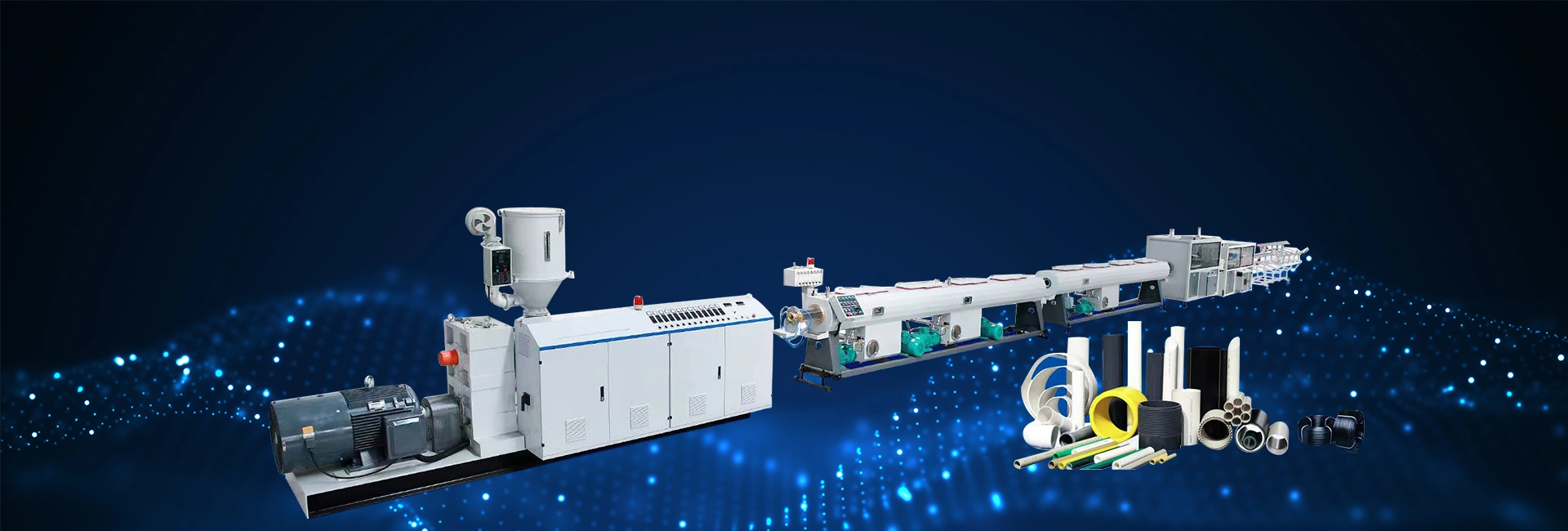
Xjgmachine offers a range of plastic processing equipment designed for applications from compounding to thermoforming. Its equipment portfolio covers different production requirements, with an emphasis on durability, efficiency, and user-friendly operation. For manufacturers, the practical advantage of working with an equipment provider across several processing categories is the opportunity to discuss the production process as a whole rather than evaluating a single machine in isolation.
When discussing a project with Xjgmachine, prepare the product drawing, material specification, target output, required dimensions, and available factory utilities. This information makes it easier to identify a suitable machine configuration and determine which auxiliary equipment is necessary.
What Information Should You Send for a Machine Proposal?
Product name and intended application.
Material type, grade, formulation, and recycled content if applicable.
Product drawing, cross-section, diameter, width, thickness, or dimensional range.
Required output per hour or per shift.
Target production speed and acceptable product tolerances.
Available factory power, cooling water, compressed air, and floor space.
Preferred automation level and operator availability.
Target budget, delivery schedule, and future capacity plans.
For a project involving pipes, profiles, rubber seals, or recycled pellets, these details are more useful than asking for a generic price list. They help the manufacturer propose a machine that can produce the required product rather than simply meet a headline specification.
Our Expert Recommendation: Choose the Extrusion Process Before the Machine Model
From our experience, the most expensive extrusion purchasing mistakes happen when buyers start with a machine model instead of a product requirement. A factory may ask for a high-output extruder, only to discover that its die, cooling system, feeding arrangement, or material preparation equipment cannot support the target production rate.
For beginners, a conventional single-screw extruder is often a practical option for suitable standard thermoplastics. For compounding and demanding mixing applications, a properly configured twin-screw system deserves serious consideration. For pipe, profile, film, sheet, rubber, or pellet production, evaluate a complete line designed around the finished product.
For heavy-duty applications, pay particular attention to screw and barrel materials, gearbox capacity, motor and drive selection, temperature control, filtration, and maintenance access. These details influence reliability more directly than a broad claim about machine power.
For commercial users, we recommend comparing suppliers on actual production performance, energy consumption, quality consistency, spare-part availability, and technical support. Ask for a clear scope of supply and agree on acceptance criteria before placing an order.
The right extrusion machine is not necessarily the largest or most expensive. It is the machine that processes your material reliably, produces saleable products at the required rate, and delivers an operating cost your business can sustain.
Frequently Asked Questions About Different Types of Extrusion Machines
1. What are the main different types of extrusion machines?
Common types include single-screw extruders, twin-screw extruders, plastic pipe extrusion lines, profile extrusion lines, sheet and board extrusion lines, film extrusion machines, rubber extrusion lines, and pelletizing or granulating extrusion systems. The correct type depends on the material, product shape, and production requirements.
2. What is the difference between a single-screw and twin-screw extruder?
A single-screw extruder uses one screw to convey, melt, and pressurize material. A twin-screw extruder uses two screws and can provide more specialized conveying and mixing behavior. Single-screw machines are common for conventional extrusion, while twin-screw configurations are frequently selected for compounding and applications requiring controlled mixing.
3. Which extrusion machine is best for plastic pipe production?
The best machine depends on the pipe material, diameter, wall thickness, and required output. PE pipe lines commonly use suitable single-screw configurations, while PVC pipe processing may require a different screw and line arrangement. A complete system should include the appropriate die, sizing, cooling, haul-off, and cutting equipment.
4. What is a profile extrusion machine used for?
A profile extrusion machine produces continuous products with a defined cross-section. Common applications include window and door profiles, cable trunking, decorative trims, thermal-break strips, and industrial plastic components. Die design and calibration are critical for dimensional accuracy.
5. What is the difference between plastic extrusion and rubber extrusion?
Plastic extrusion generally processes thermoplastics by heating and shaping the material through a die, followed by cooling. Rubber extrusion processes elastomer compounds and often requires a downstream curing or vulcanization stage. The equipment, temperature control, material behavior, and finishing process are therefore different.
6. What materials can extrusion machines process?
Depending on the machine design, extrusion equipment can process materials such as PE, PP, PVC, PA66, PLA, and various rubber compounds. Specialized lines can also process suitable recycled plastics and filled formulations. Material grade, additives, moisture, and formulation must be considered when selecting the machine.
7. What factors affect the price of an extrusion machine?
Price depends on machine size, screw configuration, motor and gearbox capacity, automation, material compatibility, die and tooling, auxiliary equipment, output requirements, and customization. A complete production line generally costs more than a standalone extruder because it includes downstream equipment and integrated controls.
8. How do I choose an extrusion machine manufacturer?
Choose a manufacturer with experience in your material and product category. Review machine configuration, output at your actual specification, energy use, tooling, quality-control procedures, spare-part availability, installation support, and warranty. Request a technical proposal and sample or production trial where practical.
9. Can one extrusion machine produce different products?
Some extrusion machines can produce different products by changing dies, calibration tools, and process settings, provided the materials and product dimensions fall within the machine's design range. However, one machine cannot efficiently replace every specialized extrusion line. Confirm changeover requirements and actual operating limits with the manufacturer.
10. Is an extrusion machine suitable for plastic recycling?
Yes. Pelletizing and granulating extrusion systems are commonly used to process suitable recycled plastics into reusable pellets. The correct configuration depends on polymer type, contamination, moisture, feedstock form, filtration requirements, and target pellet quality. Pre-sorting and material preparation are essential to reliable operation.
References
The following technical and standards organizations provide authoritative background on polymer processing, plastics testing, and industrial machinery safety. Their resources are useful when defining material requirements and preparing equipment acceptance criteria.
Plastics Industry Association — Industry resources covering plastics manufacturing, processing, and equipment applications.
ASTM International — Standards and test methods relevant to plastics, polymer materials, and product performance.
International Organization for Standardization (ISO), TC 61: Plastics — International standardization work relating to plastics, including material testing and terminology.
Looking for an Extrusion Machine for Your Production Line?
Share your material, product drawing, target dimensions, and production capacity with Xjgmachine. A machine proposal should be based on the complete manufacturing process, including extrusion, tooling, cooling, calibration, haul-off, and downstream handling.
Explore the Xjgmachine plastic extruder range and discuss the configuration that matches your production requirements.