The plastics extrusion industry has entered an era of absolute precision. Gone are the days when manufacturers could rely on manual machine calibrations and accept high scrap rates as the cost of doing business. In 2026, raw material prices—specifically PVC resin and additives—are volatile. To protect profit margins, facility directors and plant managers must demand highly engineered, automated extrusion lines that guarantee zero material waste and continuous 24/7 operation.
From our experience engineering and deploying plastic processing solutions globally at Xjgmachine, a staggering number of buyers focus entirely on the initial capital expenditure (CAPEX) of an extrusion line, completely ignoring the mechanical nuances that dictate operational expenditure (OPEX). If you purchase a generic extrusion line without evaluating the Features of PVC Pipe Manufacturing Machines, you will bleed money through excessive energy consumption, inconsistent pipe wall thickness, and catastrophic thermal degradation of your PVC compounds. This comprehensive guide cuts through the marketing noise, detailing the exact features you must specify to ensure your production line is commercially viable and ready for heavy-duty applications.
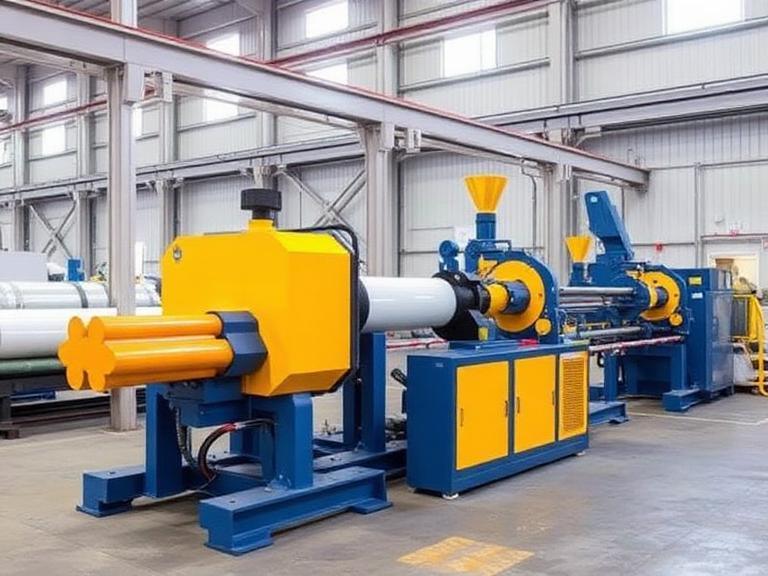
The defining Features of PVC Pipe Manufacturing Machines separate basic, low-yield operations from highly profitable, automated plants. The most critical features you must demand include:
Conical Twin-Screw Extrusion: Essential for processing heat-sensitive PVC powder uniformly without burning.
Gravimetric Dosing Systems: Ensures the precise weight-per-meter of the pipe, preventing you from giving away free raw material.
Vacuum Calibration Technology: Guarantees exact outside diameters and perfect roundness (ovality) immediately after the die head.
Multi-Caterpillar Haul-Offs: Provides smooth, synchronous traction to pull the pipe through the line without crushing or deforming the hot plastic.
If an equipment supplier cannot provide these core technological features backed by Siemens or B&R PLC automation, walk away. Their equipment will not survive modern commercial production environments.
A PVC Pipe Production Line is a synchronized series of heavy industrial machinery designed to transform dry PVC powder and chemical additives into rigid, perfectly dimensioned pipes. These pipes are utilized globally for municipal water supply, sewage drainage, electrical conduit, and agricultural irrigation.
Unlike flexible tubing or film production, rigid PVC requires an entirely different mechanical approach. PVC is exceptionally sensitive to shear heat and will rapidly degrade (burn) if not processed correctly. Therefore, the equipment must feature highly specialized screw geometries and pinpoint thermal management systems to ensure the polymer melts uniformly without degrading.
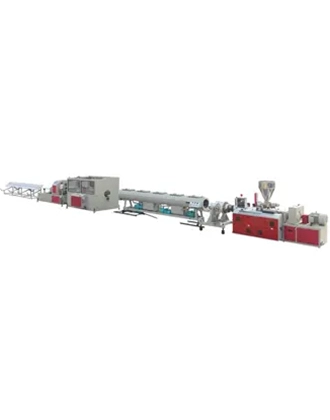
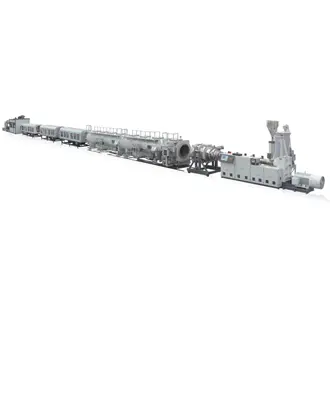
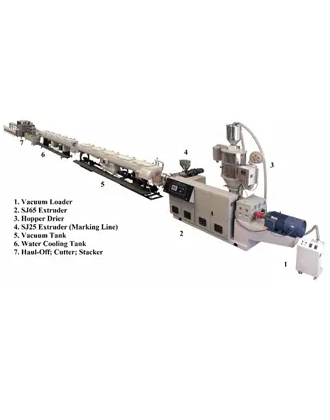
How a Plastic Pipe Production Line works is a masterclass in thermodynamics and fluid mechanics. The process begins when raw PVC powder is drawn into a heated barrel containing two rotating screws. The friction and external barrel heaters melt the powder into a viscous dough. This melt is forced under immense pressure through a steel die head, which shapes the plastic into a hollow tube.
As the glowing hot, malleable tube exits the die, it enters a vacuum calibration tank where negative pressure pulls the plastic against a sizing sleeve while cold water freezes its outer layer. The pipe is then continuously pulled by a haul-off machine, cooled completely in long spray tanks, and finally cut to precise lengths by a planetary cutter.
To operate profitably, your equipment must possess the following twelve advanced features. Missing even one of these components will compromise your final product quality.
You cannot use a standard single-screw extruder for rigid PVC powder. The primary feature of a modern PVC line is the conical twin-screw extruder. The converging design of the screws compresses the dry powder, generating the exact amount of shear necessary to melt the PVC without burning it. Furthermore, it pushes the high-viscosity melt forward with immense, stable pressure, ensuring continuous output.
In our testing, operating without a gravimetric dosing system is the fastest way to lose money. This feature continuously weighs the raw material entering the extruder and links it to the haul-off speed. It guarantees that the weight per meter of the pipe is exactly as specified by industry standards (like ASTM or ISO). If your pipe is 5% thicker than required, you are giving away 5% of your resin for free.
When the pipe leaves the die, it is soft. The vacuum calibration tank utilizes high-efficiency vacuum pumps to pull the exterior of the pipe against a brass sizing sleeve. This feature is responsible for the exact outer diameter (OD) and perfect roundness of the pipe, ensuring that it will fit flawlessly into standard pipe fittings later on.
Pulling large diameter PVC requires massive, even traction. Depending on the pipe size, advanced machines feature 2, 3, 4, 6, or even 8 caterpillar tracks. The servomotor-driven caterpillars grip the pipe evenly from all sides, preventing ovality or crushing, while maintaining the exact line speed required to control wall thickness.
For heavy-duty applications, a standard guillotine cutter will shatter thick-walled PVC. A planetary cutter revolves around the pipe, making a clean, dust-free incision using a specialized saw blade. More importantly, premium cutters feature an automatic chamfering function, creating a beveled edge on the pipe end so it can easily slide into rubber-gasketed fittings in the field.
Modern extrusion lines are not operated by dials and switches. The integration of advanced Programmable Logic Controllers (PLCs) brings Industry 4.0 capabilities to the factory floor. These systems provide real-time data logging, recipe storage, remote troubleshooting, and synchronized speed control across the entire line, ensuring that if the extruder speeds up, the haul-off speeds up simultaneously.
For commercial users producing electrical conduits or small-diameter water pipes (16mm-32mm), running a single pipe is incredibly inefficient. Features like the PVC Pipe (4-output) Production Line allow a single extruder to feed a specialized die head that extrudes two, or even four, pipes simultaneously, drastically reducing energy and labor costs per unit.
To combat rising resin prices, modern machines feature co-extrusion blocks. This allows manufacturers to extrude a pipe with virgin PVC on the inner and outer skins, while utilizing recycled PVC or a calcium carbonate foam core in the middle layer. This feature alone can reduce raw material costs by up to 30%. Facilities often pair this with a PVC/WPC Pelletizing Line to recycle their own in-house scrap.
To reduce costs, many pipe formulations use high percentages of Calcium Carbonate (CaCO3) as a filler. This acts like sandpaper inside the machine. A critical feature of premium machines is a bimetallic coating applied to the screws and barrel, extending their operational lifespan by 300% under highly abrasive conditions.
Because PVC is highly heat-sensitive, the barrel must be cooled as precisely as it is heated. Advanced machines feature individual cooling fans and closed-loop oil or water cooling systems integrated directly into the screw core, ensuring the melt temperature never exceeds the degradation threshold.
Large diameter, thick-walled pipes retain immense heat. If not cooled rapidly, the pipe will sag out of roundness before reaching the haul-off. Extended stainless steel spray cooling tanks with high-volume spray nozzles rapidly crystallize the polymer structure, locking in the dimensions.
The final feature of a world-class line is an inline belling machine. As the pipe is cut, it is automatically transferred to an oven where one end is heated and expanded (belled) to create a socket for jointing. This eliminates secondary offline processing, saving floor space and labor.
Investing in machines equipped with these features transforms your operational economics. From our experience, automated lines reduce scrap rates from an industry average of 5% down to under 1%. The precision of gravimetric dosing allows you to run pipes at the exact minimum wall thickness allowed by standards, saving hundreds of thousands of dollars in resin annually.
Despite the advanced technology, PVC pipe production lines have distinct limitations. The most prominent limitation is their lack of cross-material flexibility. You cannot successfully run High-Density Polyethylene (HDPE) or Polypropylene Random Copolymer (PPR) on a PVC twin-screw line. If your market demands flexible pressure pipes, you must invest in a dedicated HDPE Pipe Production Line or PPR Pipe Production Line, which utilize single-screw geometries engineered for polyolefins.
| The Pros (Benefits) | The Cons (Limitations) |
|---|---|
| High-volume, continuous 24/7 production capabilities. | High initial capital expenditure (CAPEX). |
| Drastic reduction in raw material waste via gravimetric dosing. | Requires highly trained operators for PLC management. |
| Co-extrusion allows for the profitable use of recycled materials. | Inflexible; cannot easily switch to producing HDPE/PPR. |
| Inline belling entirely removes secondary manual labor steps. | Requires substantial floor space (30 to 50 meters in length). |
For commercial users: Large-scale infrastructure suppliers, construction material manufacturers, and municipal contractors must utilize these advanced PVC lines. The ability to produce pipes up to 800mm (or larger) requires the heavy-duty haul-offs and planetary cutters found only on premium machinery.
Who does not need it: Small workshops looking to produce flexible hosing, automotive weather stripping, or medical tubing. For these applications, the immense torque of a twin-screw PVC line is useless. You should instead evaluate a Rubber Extrusion Line or an EPDM Rubber Seal Strip/Profile Extrusion Line to handle elastomeric compounds.
We routinely see buyers make the exact same catastrophic purchasing errors:
Under-sizing the Cooling Tanks: Trying to save money by purchasing a shorter spray cooling tank limits your maximum line speed. If you run the extruder at full capacity, the pipe will exit the short tank still warm and immediately deform in the haul-off.
Skipping the Bimetallic Barrel: If you plan to use cheap formulations heavily loaded with calcium, a standard nitrided barrel will wear out in under 12 months. Pay the premium for bimetallic treatment upfront.
Ignoring Waste Management: Extrusion lines generate startup scrap. Failing to purchase auxiliary recycling equipment, like a PE PP Pelletizing/Granulating Line or a crusher, leaves you with mountains of unusable waste.
When you sit down to write a purchase order, you must perform a strict cost-benefit analysis based on your target pipe diameters. For small diameter conduits (16mm to 32mm), purchasing a massive single-output line is a waste of energy. You must leverage multi-strand technology.
| Feature Requirement | Single Output PVC Line | PVC Double Pipe Production Line |
|---|---|---|
| Target Pipe Diameter | Large (110mm to 800mm+) | Small to Medium (16mm to 63mm) |
| Energy Efficiency per Meter | Standard | Highly Efficient (Two pipes from one motor) |
| Floor Space Required | Standard footprint | Slightly wider, but replaces the need for two separate lines |
| Operator Complexity | Lower (Managing one set of parameters) | Higher (Managing two calibration tanks simultaneously) |
We recommend that any manufacturer serious about capturing market share in the municipal or construction sectors absolutely refuse to compromise on gravimetric dosing, PLC automation, and bimetallic screw treatments. If you want to future-proof your facility, you need equipment engineered for heavy-duty, relentless production.
For manufacturers looking to dominate the large-diameter municipal pipe market, we explicitly recommend our flagship model below. It incorporates every advanced feature discussed in this guide, ensuring flawless dimensional accuracy for high-pressure sewer and water main applications.
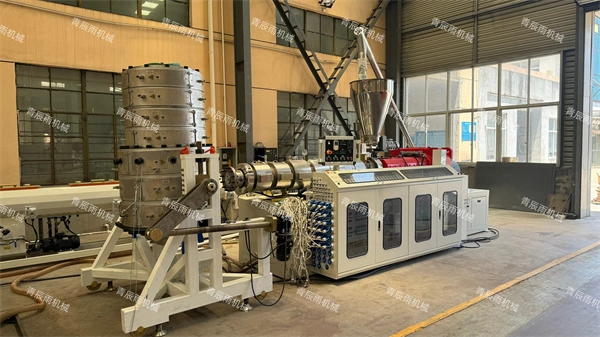
We offer a comprehensive range of Plastic Processing Equipment that includes cutting-edge technology and high-quality machines. Our equipment is suitable for various plastic processing applications, prioritizing durability, efficiency, and user-friendliness to meet the demands of modern plastic production.
Pipe Diameter Range: 400mm - 800mm
Vacuum Calibration Tank: 8000mm length for massive heat extraction
Spraying Cooling Tank: 6000mm length
Hauler: 8 Caterpillars (Heavy-duty traction without deformation)
Cutter: Planetary Cutter (Dustless, automatic chamfering)
The core Features of PVC Pipe Manufacturing Machines include conical twin-screw extrusion for processing PVC powder, gravimetric dosing for precise material control, vacuum calibration for accurate sizing, multi-caterpillar haul-offs for traction without deformation, and planetary cutters for clean, chamfered cuts.
In most professional situations, no. PVC requires a conical twin-screw extruder to handle heat-sensitive powder, while HDPE utilizes a single-screw extruder designed for melting resin pellets. Manufacturers must purchase a dedicated HDPE Pipe Production Line for polyolefins.
Gravimetric dosing continuously measures and adjusts the weight of the material entering the extruder per meter of pipe. This prevents the costly mistake of producing pipes that are thicker or heavier than the required standard, saving commercial users up to 5% in raw material costs annually.
To ensure your manufacturing outputs meet global compliance, we recommend referencing the following authoritative organizations and standards governing plastic pipe production:
ASTM International - Governing standards such as ASTM D1785 (Standard Specification for Poly(Vinyl Chloride) (PVC) Plastic Pipe, Schedules 40, 80, and 120).
The Plastics Pipe Institute (PPI) - The major North American trade association representing all segments of the plastic pipe industry.
International Organization for Standardization (ISO) - Specifically ISO 1452 governing plastics piping systems for water supply and for buried and above-ground drainage and sewerage under pressure (PVC-U).
 English
 العربية
 русский
 Español
 français
 português
 Deutsch
 italiano
 Türkçe
 한국어
한국어 日本語
日本語