English
 العربية
 русский
 Español
 français
 português
 Deutsch
 italiano
 Türkçe
 한국어
 日本語

The plastic extrusion process turns polymer raw material into continuous products such as pipes, profiles, films, sheets, and tubing. Its commercial value comes from producing consistent cross-sections at a controlled output rate. But a reliable extrusion line does not depend on the extruder alone. Material preparation, screw design, temperature control, die engineering, cooling, haul-off, and cutting must work as one coordinated system.
For manufacturers planning a new production line, understanding these seven steps is essential before selecting equipment. A machine with a high advertised output can still deliver poor results if the resin is not prepared correctly, the die is unsuitable, or the downstream equipment cannot keep pace. We recommend evaluating the complete process rather than comparing extruder specifications in isolation.
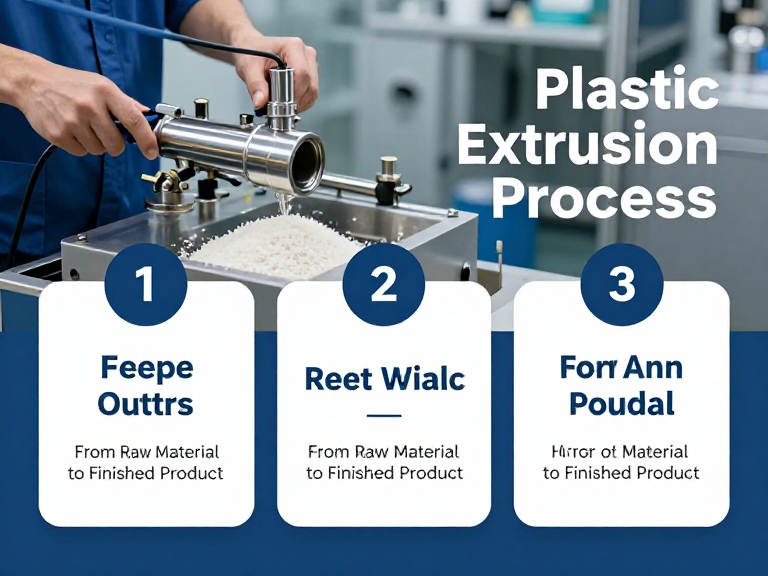
The seven main steps are: (1) raw material preparation and feeding, (2) melting and conveying, (3) mixing and homogenization, (4) extrusion through the die, (5) calibration and cooling, (6) haul-off and dimensional control, and (7) cutting, finishing, and inspection. The exact equipment and process settings depend on the polymer, product geometry, production speed, and required tolerances. For pipe and profile manufacturers, the most important decision is matching the extruder, die, cooling system, and haul-off capacity as a complete production line.
| Quick Summary Table | Main purpose | Critical control point | Typical equipment |
|---|---|---|---|
| 1. Material preparation | Prepare consistent polymer feedstock | Moisture, contamination, blend ratio | Hopper, dryer, mixer, feeder |
| 2. Melting and conveying | Transport and melt polymer | Temperature, screw speed, pressure | Barrel and screw extruder |
| 3. Mixing and homogenization | Create a uniform melt | Dispersion, melt quality, residence time | Screw elements and mixing sections |
| 4. Die forming | Shape the molten polymer | Die temperature, flow balance, pressure | Pipe, profile, sheet, or film die |
| 5. Calibration and cooling | Stabilize the product dimensions | Cooling rate, vacuum, sizing accuracy | Calibration sleeve, vacuum and cooling tanks |
| 6. Haul-off | Pull product at a stable speed | Line speed, traction, synchronization | Haul-off or caterpillar unit |
| 7. Cutting and inspection | Finish and verify the product | Length, surface, dimensions, defects | Cutter, saw, inspection equipment |
What Is the Plastic Extrusion Process?
Plastic extrusion is a continuous manufacturing process in which polymer material is fed into a heated barrel, melted and conveyed by a rotating screw, and pushed through a shaped die. The material exits the die as a continuous profile. It is then cooled, stabilized, pulled forward, and cut or wound according to the product requirements.
Unlike injection molding, which fills a closed mold to produce individual parts, extrusion is designed for continuous production. This makes it particularly suitable for products with a consistent cross-section, including HDPE pipes, PVC pipes, window profiles, plastic tubing, seals, sheets, and films.
The process may appear straightforward, but stable production requires control over several connected variables. Resin characteristics influence melting behaviour. Screw geometry affects conveying and mixing. Die design determines the initial product shape. Cooling and haul-off influence final dimensions. A weakness in one stage can create defects that appear much later in the line.
For manufacturers evaluating a new plastic extruder, the correct question is not simply how much material the machine can process per hour. It is whether the complete equipment configuration can consistently manufacture the required product at the target output, quality level, and operating cost.
The 7 Steps in the Plastic Extrusion Process
STEP 01
Raw Material Preparation and Feeding
The process begins with selecting and preparing the polymer. Common extrusion materials include polyethylene (PE), high-density polyethylene (HDPE), polypropylene (PP), polyvinyl chloride (PVC), and engineering plastics such as polyamide (PA).
Depending on the application, the feedstock may arrive as virgin resin pellets, recycled pellets, powder, or a prepared compound containing additives, pigments, fillers, and stabilizers. Before extrusion, the material must meet the requirements of the selected process and product specification.
What happens during this step?
Raw material is checked for grade, consistency, and contamination.
Moisture-sensitive polymers are dried when required by the material supplier's processing guidance.
Additives, colorants, and other components are blended according to the approved formulation.
A hopper or metering system feeds material into the extruder at a controlled rate.
Not every polymer requires the same preparation. For example, moisture control is particularly important for many hygroscopic engineering plastics. Some polyolefin applications have different drying requirements. Follow the resin supplier's technical data rather than applying one drying rule to every material.
Practical recommendation: If output fluctuates or the finished product shows inconsistent colour, bubbles, or surface defects, inspect the material supply and feeding system before immediately changing screw speed. An unstable feed rate can make the entire extrusion process difficult to control.
STEP 02
Melting and Conveying in the Extruder
After feeding, the polymer enters the heated barrel. A rotating screw conveys the material forward while heat from the barrel and mechanical energy generated by screw rotation help soften and melt it.
The screw normally contains functional sections that support feeding, compression, melting, and conveying. Their geometry depends on the polymer, the required output, and the intended application. Barrel heaters provide controlled external heat, while the screw contributes mechanical work to the melting process.
Key operating variables
Barrel temperature: Must suit the polymer and processing window.
Screw speed: Influences throughput, shear, and melt behaviour.
Back pressure and melt pressure: Affect process stability and equipment loading.
Residence time: Must be controlled to avoid inadequate melting or excessive thermal exposure.
A common mistake is assuming that increasing temperature will solve every melting problem. Excessive heat can degrade heat-sensitive polymers, while insufficient heat may leave unmelted material or create unstable flow. Temperature settings should be developed around the actual resin grade, screw design, and production conditions.
For general-purpose thermoplastic processing, a SJ single screw extruder is a common equipment choice. The final configuration should be selected according to the polymer and product rather than by screw diameter alone.
STEP 03
Mixing and Melt Homogenization
As the polymer moves through the screw, it must become sufficiently uniform before reaching the die. Mixing and homogenization help distribute heat, additives, pigments, and other formulation components through the melt.
Good melt quality is essential for consistent colour, mechanical properties, surface appearance, and dimensional stability. Poor mixing can cause visible streaks, uneven filler distribution, inconsistent product strength, and local variations in melt temperature.
The mixing requirement varies significantly by material. A straightforward PE pipe formulation may need a different screw configuration from a PVC compound or a glass-fibre-reinforced engineering plastic. The goal is not maximum shear. It is the right balance of mixing quality, output, and thermal control.
Practical recommendation: If the product shows recurring colour variation or inconsistent surface quality, review material blending, feeding stability, and screw configuration together. Do not assume the die is responsible for every defect.
STEP 04
Extrusion Through the Die
Once the polymer reaches a suitable melt condition, the screw pushes it through a die. The die determines the initial cross-sectional shape of the extruded product.
Different applications require different die structures. Pipe extrusion uses an annular die to form a hollow product. Profile extrusion uses a die shaped around the required cross-section. Sheet and film extrusion use wider die openings designed to distribute the melt across a larger width.
Why die design matters
The die must distribute melt flow evenly and maintain suitable pressure and temperature conditions. Uneven flow can cause inconsistent wall thickness, dimensional variation, surface defects, or product distortion. A die that is poorly matched to the material and output target can restrict production even when the extruder itself has sufficient capacity.
For manufacturers, die design should be reviewed alongside the intended resin, product dimensions, output rate, and downstream calibration system. A high-output extruder cannot compensate for a die that produces unstable flow.
Practical recommendation: Before approving a production line, ask the equipment supplier how the die is designed for your specific product dimensions and material. Request sample production or a documented design review where possible.
STEP 05
Calibration and Cooling
After leaving the die, the hot plastic must be cooled and stabilized so it retains the required shape. This stage is especially important in pipe and profile extrusion, where dimensional accuracy directly affects installation, sealing, and product performance.
Depending on the product, cooling may involve air, water, vacuum calibration, cooling tanks, or a combination of methods. Pipe lines commonly use sizing sleeves and vacuum calibration to control the outer diameter while the material cools. Profiles may require shaped calibration tools to hold complex cross-sections.
What operators need to control
Cooling temperature and water circulation.
Vacuum level where vacuum calibration is used.
Product contact with the calibration tooling.
Cooling length and line speed.
Dimensional stability after the product leaves the cooling section.
Cooling too quickly or unevenly can contribute to internal stress, warping, shrinkage variation, or dimensional instability. Insufficient cooling may allow the product to deform during haul-off or cutting.
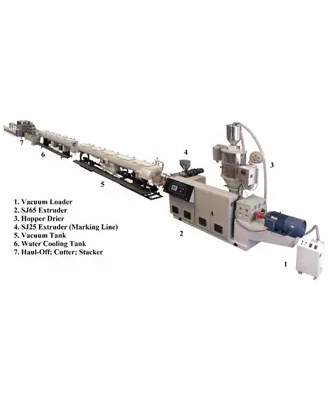
For pipe manufacturers, a properly configured HDPE pipe production line or PVC pipe production line should integrate the extrusion, sizing, cooling, and downstream sections to suit the target pipe range.
STEP 06
Haul-Off and Dimensional Control
Once the product has enough structural stability, a haul-off unit pulls it through the downstream equipment at a controlled speed. Pipe and profile extrusion commonly use caterpillar-style haul-off systems that grip the product and maintain consistent movement.
Haul-off speed must be synchronized with extruder output. If the haul-off pulls too quickly, the product may stretch, reduce in diameter, or become dimensionally inconsistent. If it moves too slowly, material may accumulate or distort between process stages.
For pipe production, stable pulling is particularly important because it influences wall thickness, outside diameter, and overall dimensional consistency. The haul-off must provide adequate traction without damaging or deforming the product surface.
Practical recommendation: When adjusting line speed, make coordinated changes and monitor the finished dimensions. Do not use haul-off speed as an isolated production control without considering melt output and cooling capacity.
STEP 07
Cutting, Finishing, and Quality Inspection
The final step converts the continuous extruded product into a usable commercial product. Depending on the application, it may be cut to length, wound into coils, marked, drilled, chamfered, or prepared for further assembly.
Pipe production commonly uses synchronized cutting equipment to produce specified lengths without interrupting the extrusion process. Profiles and sheets may require different cutting or winding arrangements.
Quality inspection should cover the characteristics that matter to the end application. These may include outside diameter, wall thickness, length, surface finish, ovality, straightness, colour consistency, and relevant mechanical or performance properties.
For pipe products, inspection requirements should be based on the applicable product specification and market requirements. A visual check alone is not enough when dimensional tolerances or pressure performance are important.
Practical recommendation: Build inspection into normal production rather than treating it as a final sorting activity. Recording process settings and inspection results helps operators identify whether a defect began during feeding, melting, die forming, cooling, or haul-off.
How the Plastic Extrusion Process Works as a Complete System
The seven steps are not independent operations. They form a continuous process in which upstream conditions affect every downstream stage.
For example, an inconsistent feed rate can change the amount of material entering the screw. That changes melt pressure and output. The die then receives a less stable melt flow, while the cooling and haul-off sections may struggle to maintain the target dimensions. The result can be scrap, downtime, and additional quality checks.
Professional operators therefore monitor the process as a system. They pay attention to the relationship between material feed, screw speed, melt temperature, pressure, die performance, cooling, and haul-off speed. Stable production comes from maintaining a suitable operating window, not from repeatedly making large adjustments to individual settings.
Types of Plastic Extruders and Where They Are Used
The extruder must match the polymer and product requirements. Single-screw and twin-screw machines are not interchangeable upgrades; they are designed around different processing needs.
Single Screw Extruder
Single-screw extruders are widely used for continuous thermoplastic processing, including many pipe, profile, sheet, and film applications. They are often a practical choice when the material formulation and processing requirements are relatively straightforward.
They can offer a good balance of operating simplicity, production efficiency, and equipment cost when correctly configured. Review screw geometry, L/D ratio, drive power, output range, and material compatibility before choosing a model.
Explore the SJ single screw extruder for applications where a single-screw configuration is suitable.
Conical Twin Screw Extruder
Conical twin-screw extruders are commonly associated with PVC processing, including rigid PVC pipe and profile production. Their screw arrangement and processing characteristics make them relevant to formulations that require controlled conveying, mixing, and thermal management.
For PVC applications, selecting a suitable screw and barrel configuration is particularly important because processing conditions must be controlled to avoid material degradation. A SJSZ conical twin screw extruder may be worth evaluating when the product and PVC formulation match its design.
Rubber Extrusion Equipment
Rubber extrusion is related to plastic extrusion but involves different material behaviour, processing conditions, and downstream requirements. Rubber compounds are generally processed according to their formulation and intended curing or vulcanization process.
If your factory produces sealing products or rubber profiles, a dedicated rubber extrusion line is more appropriate than assuming a thermoplastic line can be adapted without engineering changes.
Specialized Profile and Pipe Lines
Some products require a complete production line designed around a specific cross-section or application. Examples include thermal break strips, window spacer bars, and EPDM sealing profiles. These products require more than a general-purpose extruder; they need compatible dies, calibration tools, cooling, haul-off, and cutting arrangements.
PA66 GF25 polyamide thermal break strip extrusion line for reinforced polyamide profile applications.
PE/PP/PVC warm edge spacer bar extrusion line for spacer bar manufacturing.
EPDM rubber seal strip extrusion line for rubber sealing profiles.
Plastic Extrusion Process Comparison by Product Type
The process sequence remains broadly similar across extrusion applications, but the die, calibration, cooling, and downstream equipment can differ substantially. The following comparison helps manufacturers identify the type of line they should evaluate.
| Product type | Common materials | Key process requirement | Typical downstream equipment | Selection priority |
|---|---|---|---|---|
| Plastic pipe | HDPE, PVC, PPR, PP | Stable wall thickness and diameter | Vacuum sizing, cooling tank, haul-off, cutter | Dimensional control and line synchronization |
| Plastic profiles | PVC, PE, PP, PA | Accurate and repeatable cross-section | Profile calibration, cooling, haul-off, saw | Die and calibration accuracy |
| Thermal break strips | PA66 GF25 and related compounds | Reinforced profile consistency | Specialized die, calibration, cooling, cutting | Material handling and profile tolerances |
| Warm edge spacer bars | PE, PP, PVC | Stable profile dimensions and surface | Profile calibration, haul-off, cutting | Cross-section repeatability |
| Rubber seals | EPDM and other rubber compounds | Compound flow and curing compatibility | Cooling or curing equipment, cutting | Rubber-specific process design |
| Sheet and film | PE, PP, PVC, PET and others | Uniform thickness and width | Cooling rolls, winding, trimming | Die distribution and thickness control |
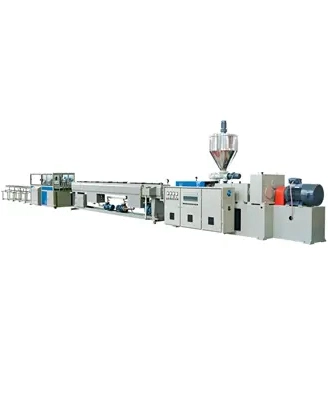
For pipe production, a dedicated plastic pipe production line is usually a better starting point than assembling unrelated machines independently. The supplier should confirm that the extruder, die, sizing, cooling, haul-off, and cutting units are matched to the pipe material and size range.
Benefits and Limitations of the Plastic Extrusion Process
Key Benefits
Continuous production: Extrusion is well suited to long products and high-volume manufacturing.
Consistent cross-sections: A properly designed die and stable process can produce repeatable profiles, pipes, and sheets.
Material flexibility: Different thermoplastics can be processed with suitable machine configurations and process settings.
Scalable production: Output can be adjusted through equipment selection and process optimization.
Product customization: Dies and downstream equipment can be designed for specific dimensions and shapes.
Automation opportunities: Feeding, temperature control, haul-off, cutting, and inspection can be integrated into a production line.
Limitations to Consider
High initial investment: A complete extrusion line may require an extruder, dies, calibration equipment, cooling, haul-off, cutting, and auxiliary systems.
Process sensitivity: Material, temperature, pressure, screw speed, and line speed interact.
Setup and changeover time: Changing materials, colours, or product dimensions may require cleaning, die changes, and process adjustments.
Scrap during startup: Material may be wasted while the line reaches stable operating conditions.
Maintenance requirements: Screws, barrels, dies, heaters, drives, and downstream components require planned inspection and maintenance.
Product limitations: Extrusion is most suitable for continuous products with a consistent cross-section, not every type of three-dimensional component.
Plastic Extrusion Process: Pros vs. Cons
| Pros | Cons |
|---|---|
| Efficient for continuous production of pipes, profiles, sheets, and films. | Not the best process for products requiring complex individual three-dimensional shapes. |
| Can deliver consistent dimensions when the line is correctly engineered and controlled. | Dimensional stability depends on several connected process stages. |
| Supports a broad range of thermoplastic materials. | Different polymers may require different screw designs, temperature profiles, and auxiliary equipment. |
| Can be automated for repeatable, high-volume manufacturing. | Automation and complete-line integration increase initial investment. |
| Custom dies enable specialized product profiles. | New products may require die development, trials, and calibration adjustments. |
| Suitable for scaling production once the process is stable. | Unplanned downtime or poor process control can quickly increase scrap and operating costs. |
Best Applications for Plastic Extrusion Equipment
Plastic extrusion is most valuable when the product has a continuous shape and the factory needs repeatable output. The choice of line should follow the product's end-use requirements rather than the general popularity of a particular machine type.
HDPE Pipe Manufacturing
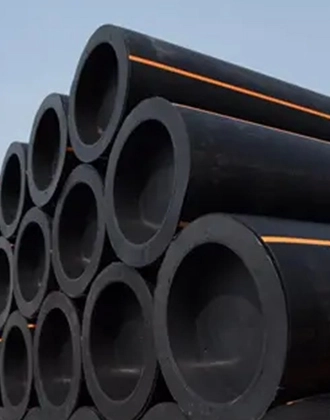
HDPE pipes are used in water supply, drainage, gas distribution where permitted by applicable standards, and industrial fluid transport. A production line must be designed around the required pipe diameter range, wall thickness, material grade, and quality requirements. Review the HDPE pipe production line as a complete system rather than comparing only the extruder.
PVC Pipe Manufacturing
PVC pipe production requires suitable material formulation and careful process temperature management. The extruder, die, sizing system, cooling, and haul-off must be configured for the intended pipe specification. A PVC pipe production line is designed around these specific production requirements.
PPR Pipe Manufacturing
PPR pipes are commonly used in hot and cold water plumbing systems. Manufacturers should evaluate the material grade, pipe dimensions, wall thickness, and applicable product standards before selecting equipment. A dedicated PPR pipe production line can help align the extrusion and downstream process with the product range.
Window and Building Profiles
Plastic extrusion is widely used for window profiles, thermal break strips, spacer bars, and sealing profiles. These products often require specialized dies and calibration equipment because even small cross-section variations can affect assembly and performance.
Common Plastic Extrusion Production Mistakes
1. Choosing a Machine Based Only on Maximum Output
Maximum output figures are not enough to determine whether a line will meet your production target. Actual output depends on material, product dimensions, die design, cooling capacity, and operating conditions. Ask for output information based on a comparable product and material.
2. Using Incorrect Temperature Settings
Every polymer has its own processing requirements. Excessive temperature may cause degradation, while insufficient temperature can lead to incomplete melting and unstable flow. Develop a temperature profile based on resin supplier guidance and production trials.
3. Ignoring Die and Calibration Compatibility
A die that produces the correct shape at the outlet does not guarantee a finished product with correct dimensions. Calibration and cooling must stabilize the product. Review these components together during line design.
4. Increasing Screw Speed to Solve Every Output Problem
Higher screw speed may increase throughput, but it can also change melt temperature, pressure, shear, and product stability. If the downstream system cannot handle the additional output, higher speed may increase defects instead of improving saleable production.
5. Neglecting Raw Material Consistency
Changes in resin grade, moisture, recycled content, additive ratio, or contamination can affect extrusion behaviour. Establish incoming material checks and consistent batch preparation procedures.
6. Failing to Synchronize the Production Line
The extruder, cooling system, haul-off, and cutter must operate in coordination. Poor synchronization can create stretching, deformation, length variation, or unstable dimensions.
7. Skipping Preventive Maintenance
Worn screws, damaged barrel surfaces, blocked dies, failing heaters, and unstable drives can reduce output and increase scrap. A preventive maintenance schedule is generally less expensive than repeatedly troubleshooting production failures after they occur.
How to Choose the Right Plastic Extrusion Machine and Production Line
For manufacturers investing in new equipment, the selection process should begin with the finished product. Define what the factory needs to produce before discussing machine models or headline output numbers.
1. Define the Product Specification
Prepare the product drawings, material grade, dimensions, tolerances, output target, and application requirements. For pipe production, specify the diameter range, wall thickness, pressure or performance requirements, and cut length. For profiles, provide the complete cross-section and dimensional tolerances.
2. Confirm Material Compatibility
Tell the manufacturer exactly which polymer and formulation you plan to process. PE, PP, PVC, PA, and rubber compounds have different processing characteristics. The supplier should explain why the proposed screw, barrel, and temperature-control configuration is suitable.
3. Compare Single-Screw and Twin-Screw Options
A single-screw extruder may be the practical choice for many continuous thermoplastic applications. A conical twin-screw configuration may be more suitable for certain PVC processing requirements. Do not pay for a more complex configuration unless it solves a real material or production problem.
4. Evaluate the Complete Line
Request specifications for the die, calibration unit, cooling tank, haul-off, cutter, and auxiliary equipment. Confirm how these components are synchronized and whether the line can accommodate the intended product range.
5. Request a Production Trial or Comparable Reference
Ask the supplier to demonstrate production using a comparable material and product specification. A useful trial should provide more than a short video of an extruder running. Review actual product dimensions, surface quality, output stability, and the operating settings used.
6. Compare Total Cost of Ownership
Purchase price is only one part of the investment. Include tooling, installation, commissioning, operator training, energy consumption, spare parts, maintenance, material waste, and expected downtime. A line with a higher purchase price may offer better value if it produces more saleable product with fewer interruptions.
7. Check Technical Support and Spare Parts
Confirm what support is available during installation and commissioning. Ask about troubleshooting, spare-part lead times, documentation, and operator training. For factories with tight delivery schedules, the ability to restore production quickly can be more important than a small difference in the initial quotation.
8. Assess the Manufacturer's Product Range
A supplier with experience in multiple extrusion applications may be better positioned to support future production changes. Xjgmachine offers plastic processing equipment for applications ranging from compounding to thermoforming, with equipment options for pipe, profile, and other plastic products.
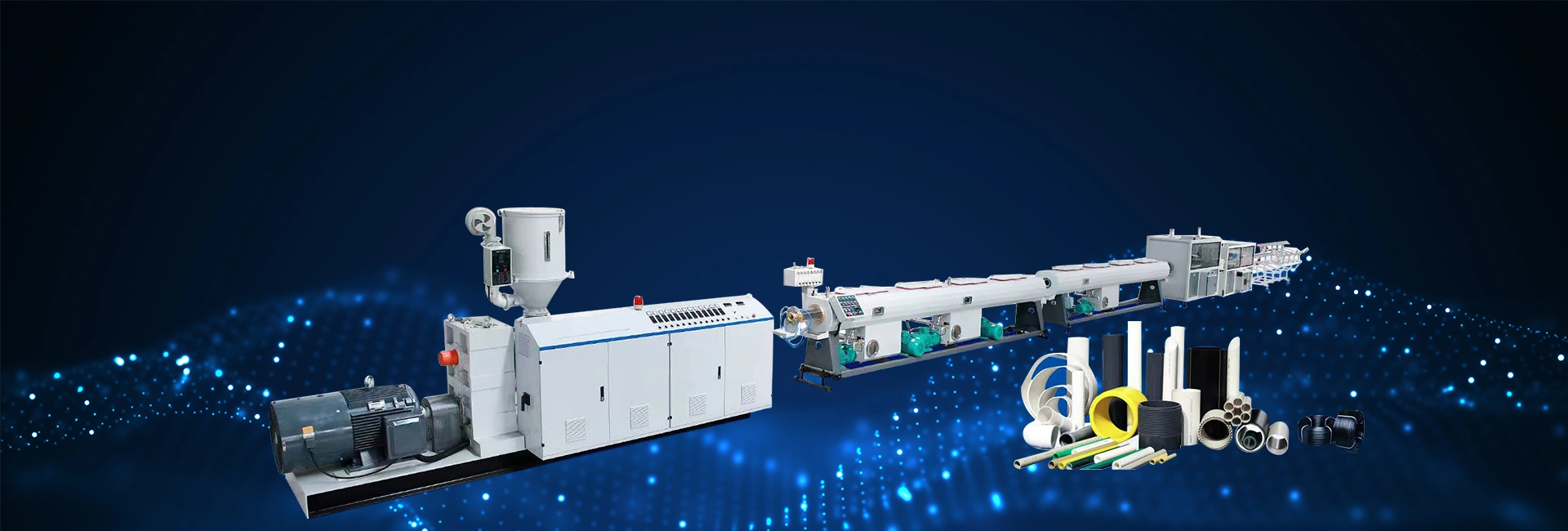
Its plastic pipe production line is relevant for manufacturers planning a coordinated pipe extrusion setup. When evaluating the equipment, confirm the proposed configuration against your actual material, pipe size range, output target, and local production requirements.
Expert Recommendation: How to Improve Plastic Extrusion Efficiency
In most professional situations, improving extrusion efficiency starts with stabilizing the process rather than immediately buying a larger machine. A production line that operates consistently at a realistic output can deliver better commercial results than a high-capacity line that creates frequent dimensional defects and material waste.
Our Recommended Priorities
Stabilize material feeding: Maintain consistent resin quality, blending, and feeding rates.
Use the correct screw configuration: Match screw design and machine type to the polymer and product.
Optimize die performance: Check melt distribution, pressure stability, and die temperature.
Improve cooling: Ensure the calibration and cooling systems can support the intended output.
Synchronize haul-off and cutting: Keep line speed and downstream operations coordinated.
Monitor product dimensions: Use regular measurement and process records to identify drift early.
Maintain equipment proactively: Inspect screws, barrels, dies, heaters, drives, and downstream components.
For beginners, we recommend starting with a clearly defined product range and a production line designed for that range. Avoid specifying a machine around an ambitious output target before confirming the resin, die, and cooling requirements.
For established manufacturers, the best upgrade may be a more efficient screw design, improved temperature control, automated feeding, better calibration, or downstream synchronization. These changes can sometimes improve saleable output without replacing the entire line.
Frequently Asked Questions About the Plastic Extrusion Process
1. What are the 7 steps in the plastic extrusion process?
The seven main steps are raw material preparation and feeding, melting and conveying, mixing and homogenization, die forming, calibration and cooling, haul-off, and cutting with quality inspection. The exact equipment varies according to the polymer and product.
2. What is the purpose of a screw in a plastic extruder?
The screw conveys polymer through the heated barrel, contributes to melting through mechanical energy, helps mix the material, and develops the pressure needed to push the melt through the die. Screw geometry should match the material and application.
3. What materials can be used in plastic extrusion?
Common materials include polyethylene (PE), high-density polyethylene (HDPE), polypropylene (PP), polyvinyl chloride (PVC), and polyamide (PA). The suitable extruder and process settings depend on the material grade, formulation, and product requirements.
4. What is the difference between single-screw and twin-screw extrusion?
A single-screw extruder uses one rotating screw and is widely used for many continuous thermoplastic products. A twin-screw extruder uses two screws and can provide different conveying and mixing characteristics. The best choice depends on material behaviour and process requirements, not a general ranking of machine quality.
5. Why is cooling important in plastic extrusion?
Cooling stabilizes the product after it leaves the die. It helps maintain the required dimensions and shape. Poor or uneven cooling can contribute to warping, shrinkage variation, internal stress, and dimensional defects.
6. What causes bubbles in extruded plastic products?
Possible causes include moisture, volatile contaminants, material degradation, unsuitable processing temperatures, or other formulation and process problems. The correct diagnosis depends on the polymer and where the bubbles appear. Check material preparation and processing records before changing several machine settings at once.
7. What causes uneven wall thickness in plastic pipes?
Uneven wall thickness may result from die centering problems, uneven melt flow, unstable material feeding, incorrect calibration, or inconsistent haul-off. Inspect the die and downstream sizing system while monitoring melt pressure and product dimensions.
8. How do manufacturers improve plastic extrusion output?
Manufacturers can improve output by stabilizing raw material feeding, optimizing screw speed and temperature settings, improving die flow, ensuring sufficient cooling capacity, and synchronizing haul-off and cutting. The best improvement depends on the actual production bottleneck.
9. Is plastic extrusion suitable for small manufacturers?
It can be suitable when the manufacturer has a consistent product demand and the expected production volume justifies the equipment investment. Smaller operations should compare the complete line cost, tooling, energy, maintenance, staffing, and material waste against outsourcing or alternative manufacturing methods.
10. How do I choose a plastic extrusion machine manufacturer?
Compare material-processing experience, machine configuration, complete-line integration, die design, production references, testing capability, technical support, spare parts, and total cost of ownership. Ask for a proposal based on your actual product specifications rather than accepting a generic machine quotation.
References
These technical and standards resources provide further information on polymer processing, plastics terminology, and pipe-system requirements.
Encyclopaedia Britannica – Plastics Processing. Background on the main methods used to process polymer materials.
Plastics Industry Association. Industry information and resources related to plastics manufacturing and processing.
International Organization for Standardization – ISO/TC 138. Standards committee covering plastics pipes, fittings, and valves for the transport of fluids.